
Biographie d’Ipoustéguy
Ipoustéguy in Thirty Key Episodes!
A life as an artist to read and to see.
“Perhaps I am somewhat marginal. I am a child of the suburbs, and the little culture I have, I acquired in evening classes and in museums.”
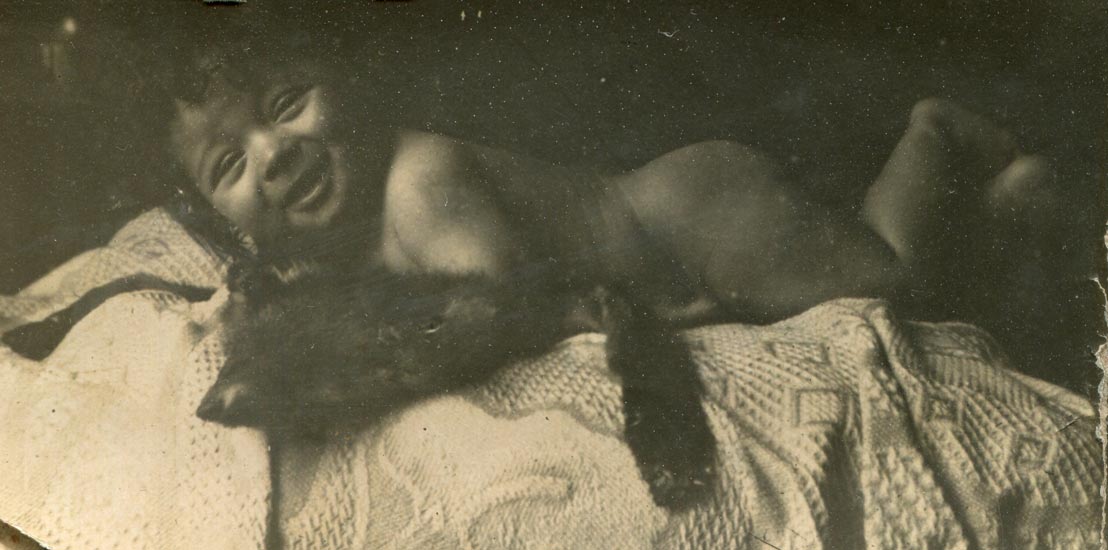
1920
Ipoustéguy, a legacy of the Great War
Jean Robert, known as Ipoustéguy, was born on January 6, 1920 in Dun sur Meuse to Eugène Robert, a carpenter from Lorraine, and Madeleine Ipoustéguy, a hairdresser from the Basque Country. They also had a daughter, his younger sister Michèle. Throughout his childhood, Ipoustéguy was immersed in the memory of the First World War, both through his proximity to the battlefields and through his family’s stories. His very existence is intimately linked to the war, as his parents met when Eugène had to flee Lorraine and take refuge in Charente. Ipoustéguy would remain steeped in this war for the rest of his life. He appreciated being taken to see American and German cemeteries, battlefields and the Douaumont ossuary.
Ipoustéguy as an infant © Personal photo
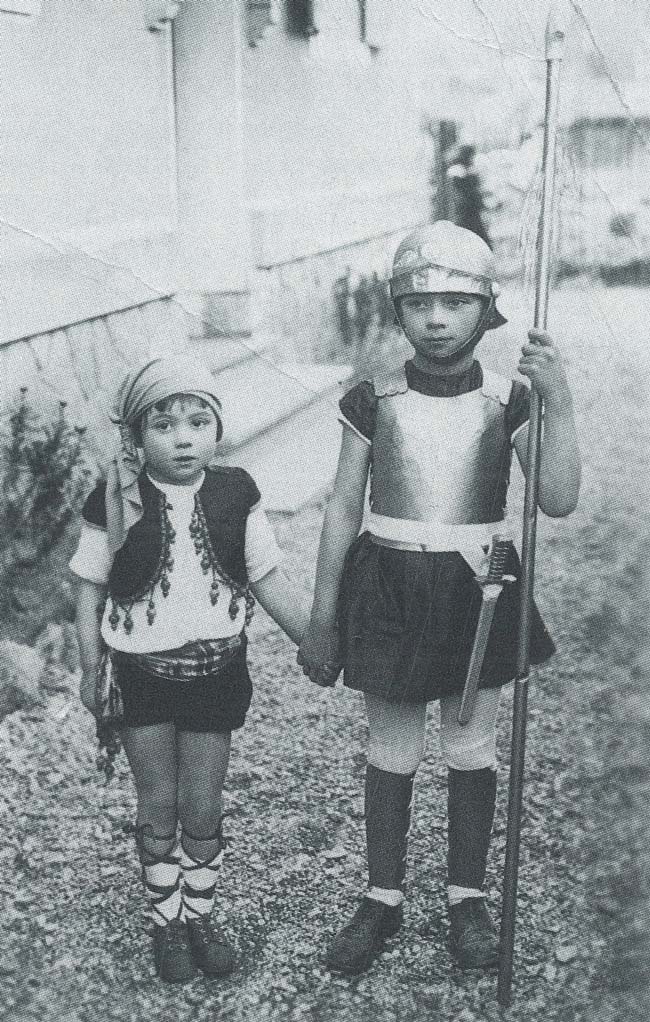
1926-1628
the birth of a vocation, against all odds
Raised in a modest family, as a child he was drawn to painting – without being encouraged to do so, far from it. But he was determined to make it his profession. His parents didn’t want to hear about it : “they considered it a dead-end job”. Yet he was gifted at drawing (one of his schoolteachers once accused him of having his father do his drawings.) – too gifted, perhaps, in this rural environment.
His mother, with her strong, dry character, could be “quick-tempered”. His gentler father enjoyed the company and – in moderation – the bistros where he could escape home life. This craftsman father, a carpenter or hairdresser when work was scarce, was good with his hands and didn’t mind painting occasionally. His son accompanied him, attracted as much by his father’s presence as by ” the smell of turpentine “. At the age of 6, he signed a perspective drawing on the back of one of his father’s works, what he would call 70 years later “the drawing of my life”. At the age of 17, he obtained the highest mark in drawing for the brevet élémentaire.
Ipoustéguy and his sister in costume © Personal photo
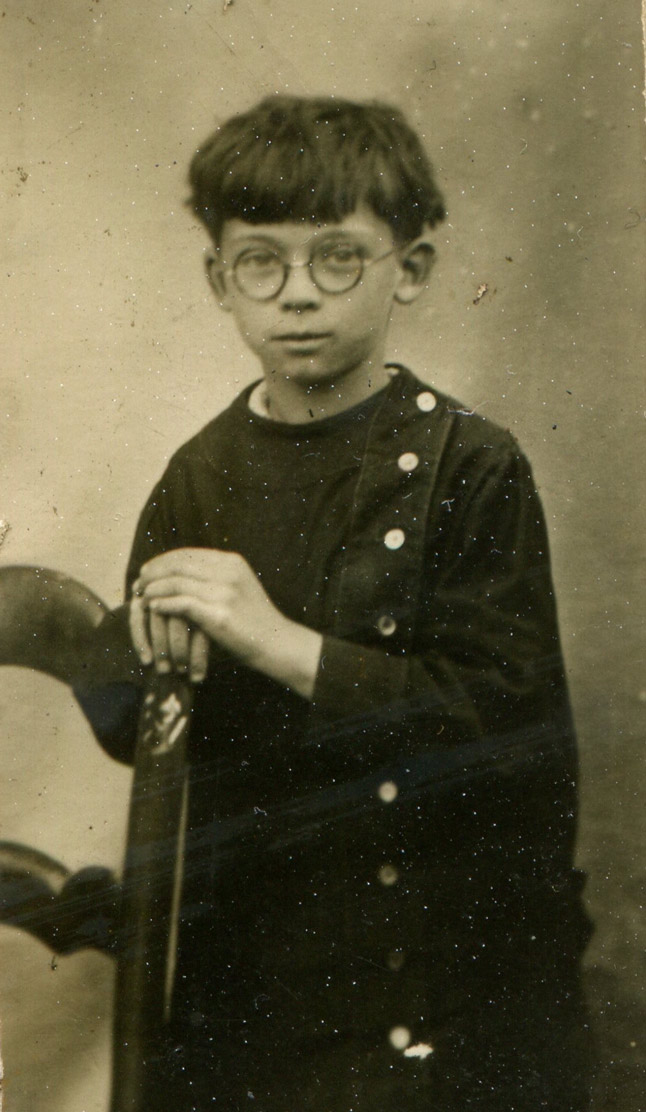
Années 30
Uprooting... and suburban glasses
When Ipoustéguy was 10 years old the family moved to Saint-Georges-de-Didonne, in the Charente, for financial reasons. Then in 1937 to Pavillon sous-bois in the Paris suburbs. Here and there, it was difficult to earn a living for this hard-working but poor couple. One anecdote will live long in his memory: Ipoustéguy was always short-sighted. His glasses were financed by the mayor of Pavillon sous-bois. Never having forgotten this episode, he donated one of his works to the municipality at the end of his life.
Ipoustéguy in school uniform © Personal photo
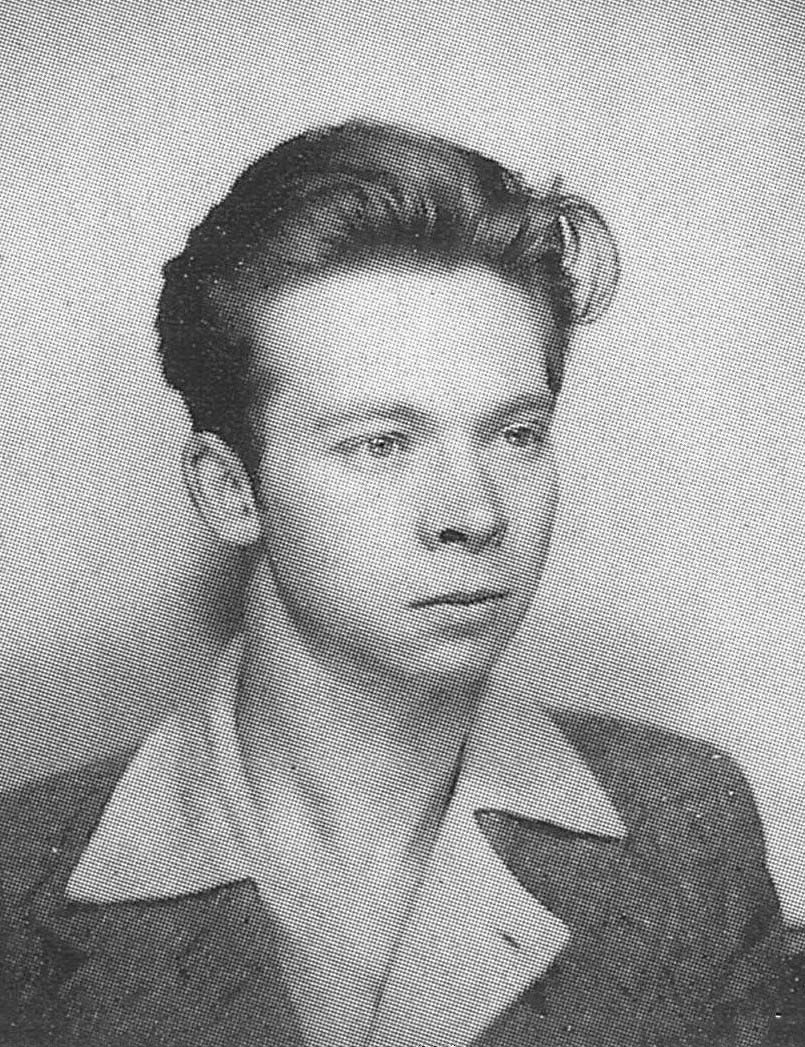
1937-1938
Discovering Arts and Culture
At the age of 17, after obtaining 20/20 in drawing for the brevet élémentaire (” my only diploma! “), Ipoustéguy went to work for Bouly, a sock manufacturer. During an errand in Paris, he encountered the world of drawing: from a bus criss-crossing the Boulevard du Montparnasse, he was attracted by the sign for the City of Paris evening classes. He enrolled! By chance, he joined the class of Robert Lesbounit, who would become both his drawing and humanities teacher. Thanks to Lesbounit, Ipousteguy discovered culture, the Louvre Museum, Jouvet’s theatre and the literature of Hemingway and Isaac Babel. A shock and a revelation for a young man who had never evolved beyond school references. It was also Lesbounit who ” christened him Ipoustéguy ” to set him apart from the other “Robert” artists at an exhibition.
Portrait of Ipoustéguy in 1939 © Personal photo
1939-1942
Survival
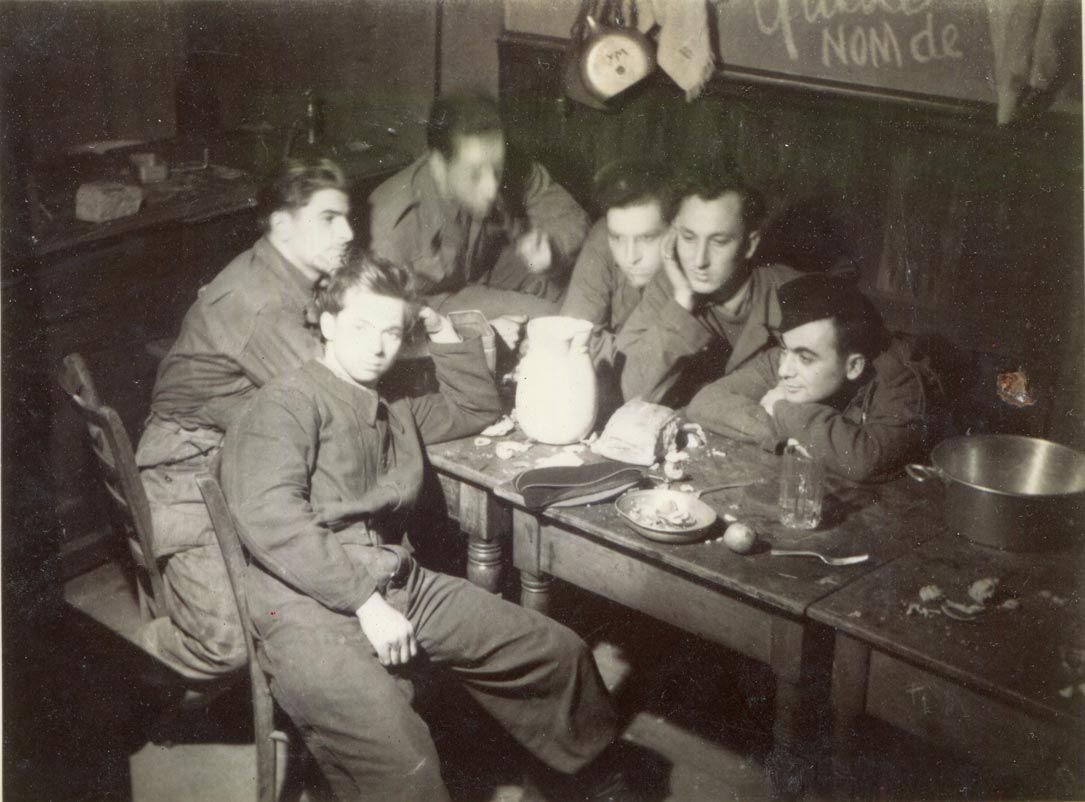
World War II broke out and as a young soldier – aged 19 – Ipoustéguy was mobilised in Dijon during the Drôle de Guerre. After the Armistice, he became a law clerk for a time – before fleeing to Saintes under a false identity to escape the compulsory work service (STO). He moved in with his uncle under the name Monsieur Dominique. He had made up his identity card himself and, thanks to his youthful appearance, was able to make himself look 6 years younger. His uncle was a “little hand” for the Resistance, but Ipoustéguy didn’t join. For the rest of his life, he never joined any political or artistic movement or organisation.
June 23, 1942 the RAF bombed Saintes. At the same time, Ipoustéguy was repainting the train timetable sign at the station. Under the deluge of bombs, a German soldier pulled him by his overalls into the bunker opposite the station. Today, on the platform of the same station, you can admire Maison de Lénine or La Conception, a marble created in 1969, donated years later to the SNCF as a reminder of this near-death experience.
Ipoustéguy in Birkenfeld, 1945, foreground left © Personal photo
1943-1946
Paris, where all is promise
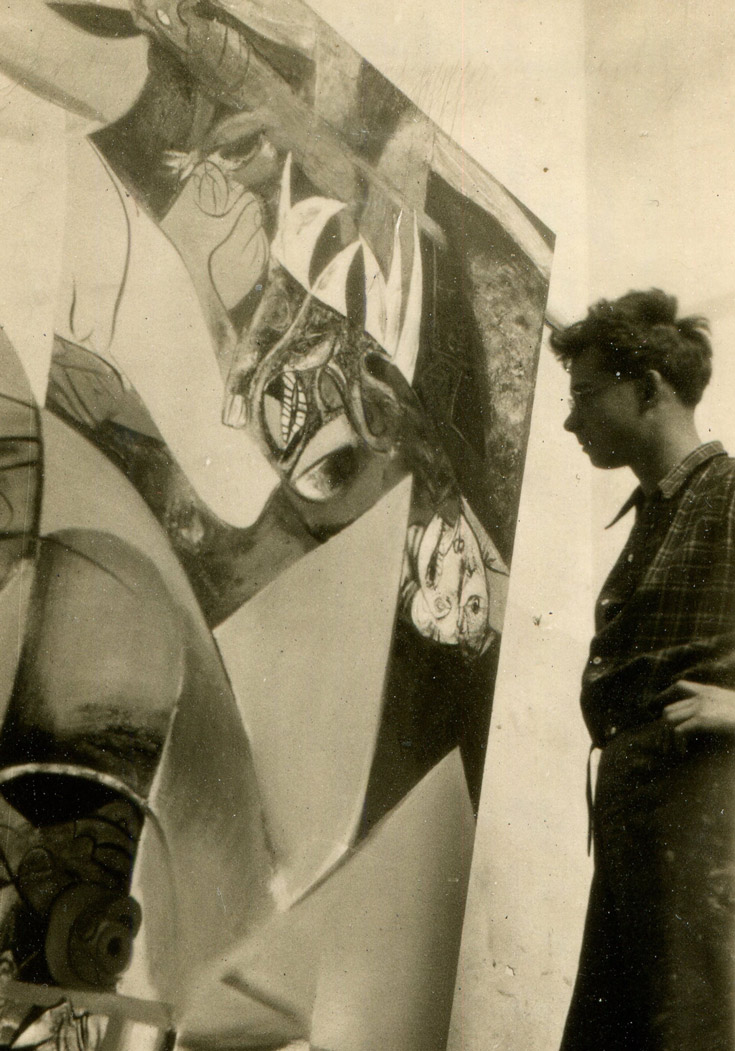
The first group exhibitions in Paris were Librairie La Hume and Salon des Moins de Trente Ans (where he exhibited regularly every year until 1950). Then Ipoustéguy changed his life by moving back to Paris, where he started writing and married Geneviève Gilles, with whom he had his first child, Dominique, born in 1945.
Ipoustéguy in front of *Bombardier*, 1946 © Personal photo
1939-1942
The turning point for sculpture, and Choisy
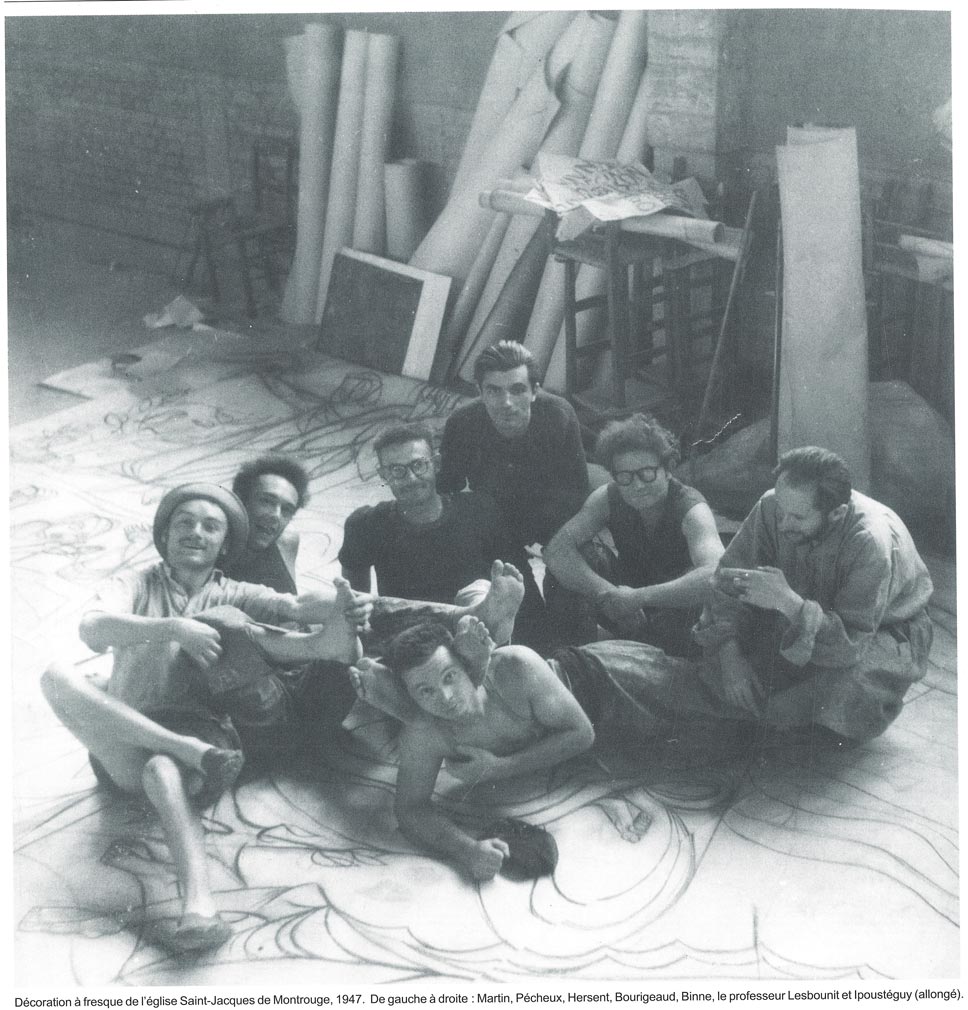
Ipoustéguy participated with his evening classmates in creating the frescoes and stained-glass windows of the Church of Saint-Jacques de Montrouge. At that time, he also discovered the Choisy-le-Roi workshops of the ceramist Le Noble. To support his family, he taught drawing in schools in Issy-les-Moulineaux. He was greatly appreciated by his students, who nicknamed him “the children’s captain.”
He rented his first studio in Choisy, and in the early 1960s, he managed to purchase “Choisy” when he joined the Galerie Claude Bernard. Ipoustéguy remained very close to all his friends from that period; some continued to paint (like Jean Martin), while others took different paths. He was deeply affected by the suicide of Roger Binne, whose footsteps he would hear at night as he slept in his studio. In 1959, he created one of his first “major” sculptures, Roger et le peuple des morts, first in cement, then in bronze.
1951
Artistic commitment embraces time
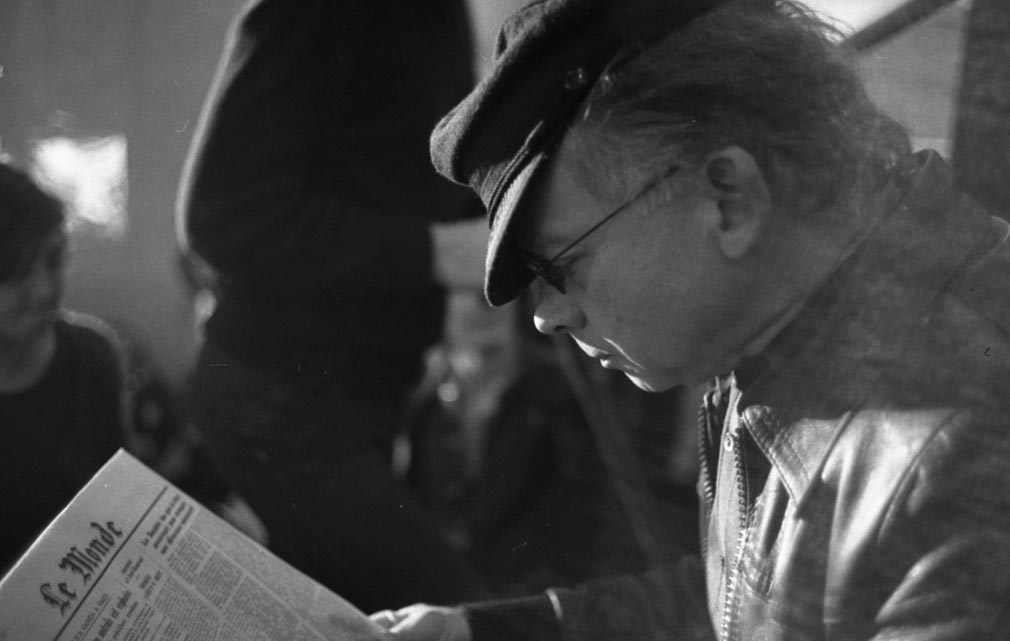
In his little “gourbi” in Choisy-Le-Roi, Ipoustéguy shaped Christ à Mac Gee. Already, the artist was sensitive to current events, their stories and images. He devours the press. Here, he pays tribute to Black American Willie MacGee, executed by electrocution in Mississippi. The death sentence sparked major protests in the United States and France.
The work remained outdoors for many years, protected by a few tarpaulins. Shaped by the elements, it was rediscovered by the artist, who had it cast in bronze at the end of his life, embellished only with a crown of thorns made from bronze scraps.
In a long interview with Evelyne Artaud, Ipoustéguy commented on this work of time and the elements: “This God is a beautiful symbol, laden day after day with all our tears. So a large part of this sculpture was made away from me, and was therefore taken out of my own formulation. It’s an exception that runs counter to everything I do, and reinforces my caution about sectarian methods.”*
The work is now installed in the heart of the Dun-Haut church, not far from Mort de l’évêque Neumann.
* Evelyne Artaud, Ipoustéguy, parlons…, Diagonales, 1993, p. 19
Ipoustéguy reading Le Monde © Despatin and Gobeli
1952-1954
Sculpting, "at your own risk!"
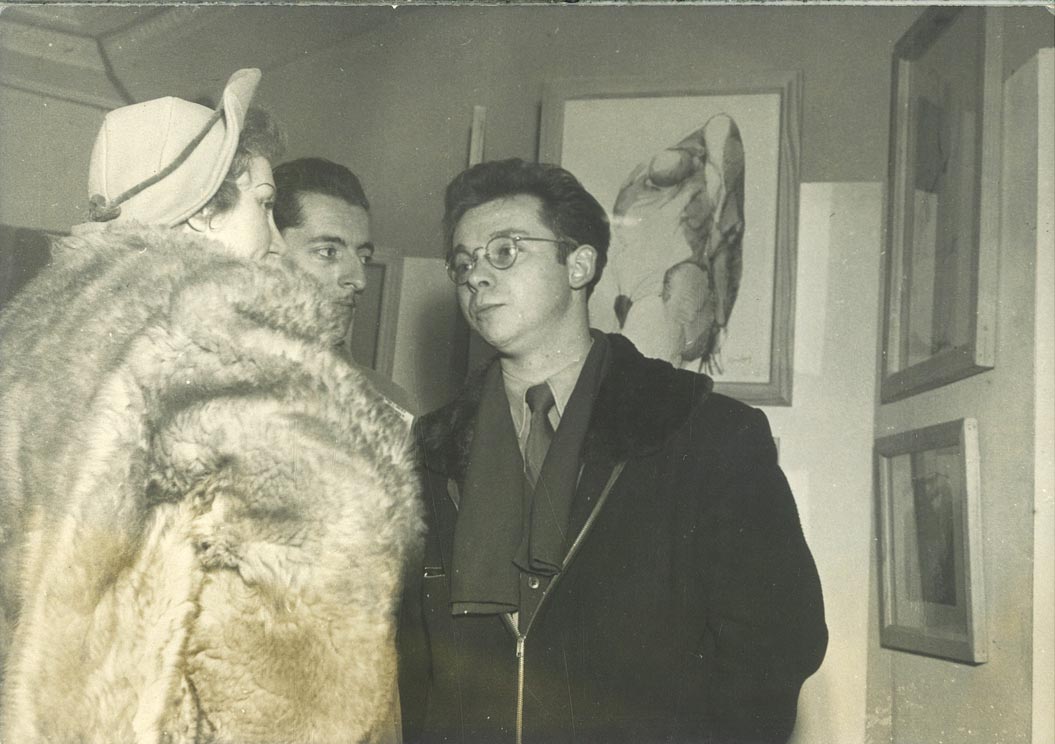
In 1952, he met Picasso’s dealer, Kahnweiler, who appreciated his work but tried to dissuade him from sculpting because it doesn’t sell*, claiming, “Don’t forget, you’ll become a sculptor at your own risk…”.
In his first assembly, with the Aurora Cruiser, he paid tribute to one of the major episodes of the October Revolution in Russia. An admirer of Russian history and culture, he often spoke of his two (unfulfilled) dreams: “to go to Lake Baikal and to exhibit on Red Square“. First group exhibition abroad. First abstract research.
* Pierre Assouline, L’Homme de l’art, D.-H. Kahnweiler 1884-1979, Gallimard, Paris, 1989
Ipoustéguy in a Right Bank gallery, in front of a drawing noticed by Kahnweiler © All rights reserved
1956-1957
Major sculpture events
His first participation in the Salon de Mai in Paris was thanks to the support of sculptor Adam (Henri Georges Adam, dit.), who sat on the selection committee. At this major event for living art at the time, Ipoustéguy proposed a plaster architectural form, Rose, a marble version of which he produced in Carrara in 1968.
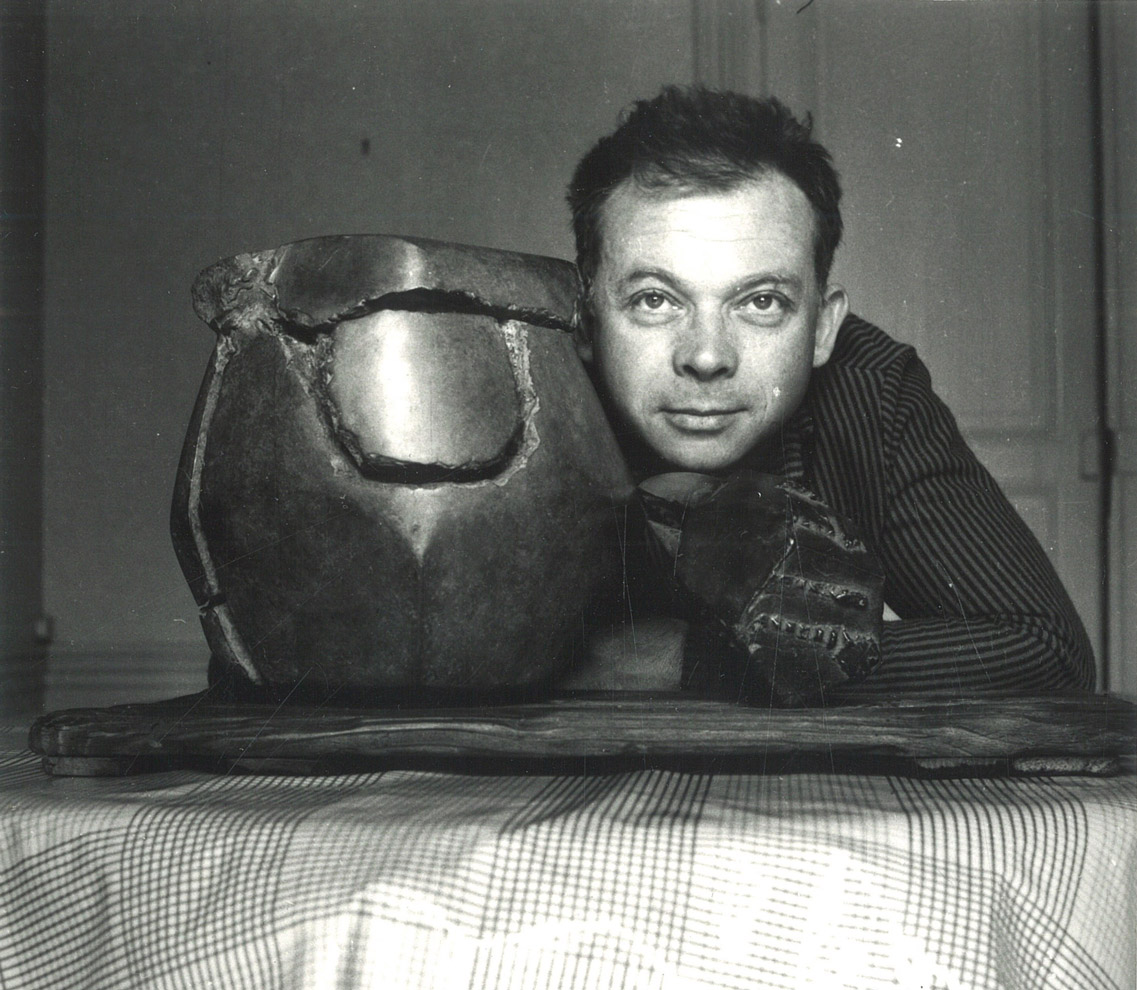
As a drawing teacher in Issy-les-Moulineaux, he took advantage of the Easter vacations to build the Cenotaph in sheet steel at the Lemnos workshops in Pantin.
At first, he named it Le Tombeau de Picasso (Picasso’s Tomb) as a tribute to the great master’s work. Around him, voices tried to dissuade him. The reason being, it could be seen as childish bravado! Ipoustéguy, who hates provocation and will never speak ill of a colleague’s work, whether in public or private, gave in. Today, the Cenotaph can be found in the collections of both the Musée d’art moderne de la ville de Paris and the prestigious MIT, Massachusetts Institute of Technology.
Ipoustéguy in front of Heaume © All rights reserved
1960
Galerie Claude Bernard, rue des Beaux-Arts
In 1960, Claude Bernard, who had discovered one of Ipoustéguy’s works at the Salon de Mai, signed him to a contract and organised his first solo exhibition in his gallery on rue des Beaux-Arts in Paris. He did a great deal for Ipoustéguy in terms of his promotion and initial support, enabling him to give up teaching drawing at the French Ministry of Education and devote himself exclusively to sculpture.
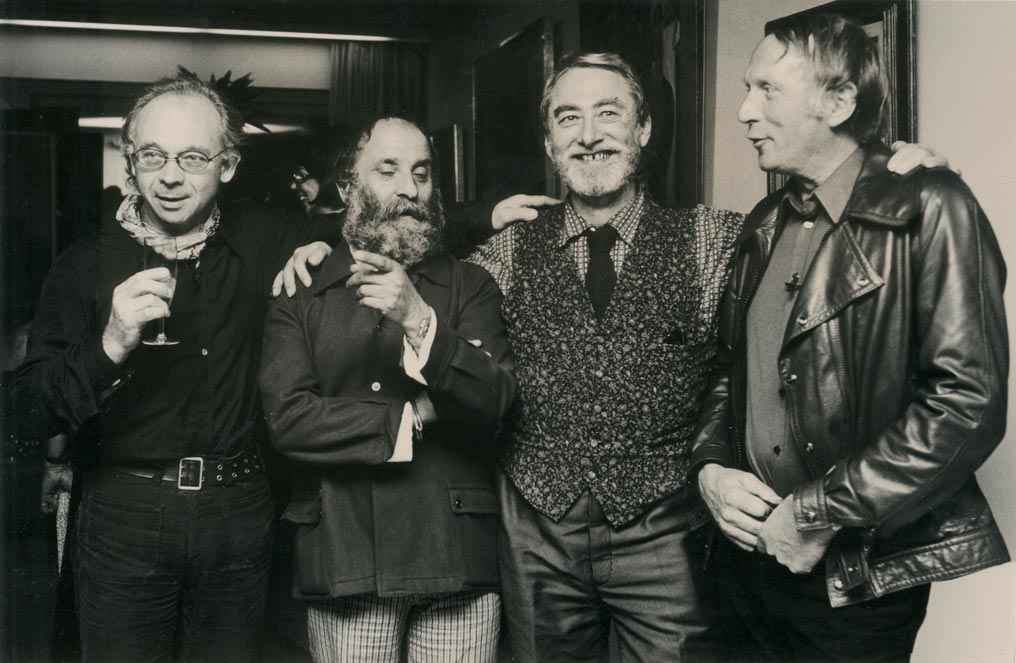
At the gallery, he met a number of other artists whom he encountered from afar but admired: César, Roel d’Haese, Raymond Masson, Crémonini, and Dodeigne.
Three years later, Ipoustéguy and César, who used to make the rounds of Left Bank galleries, spotted a young man in a group show who turned out to be Sam Szafran. Thanks to these intermediaries, Szafran also joined the Galerie Claude Bernard. *
* Anecdote tirée du hors série de Beaux-Arts magazine consacré à Sam Szafran
Ipoustéguy with César, Roel d’Haese, and Dodeigne © Rony Heirman
1962
Figurative turn and international influence
A trip to Greece with his second wife, Françoise, had a profound effect on him. Ipoustéguy was captivated by ancient art, which brought out what he had been repressing until then: the human figure. He abandoned the abstract, which had interested the critics, for the figurative. La Terre is the monumental work that embodies this aesthetic “return to basics”. The human body became Ipoustéguy’s main subject.
The following year, he sculpted L’Homme. This work is now installed in the moat of the Ministry of Economy and Finance, chosen by the project’s architect, Paul Chemetov.
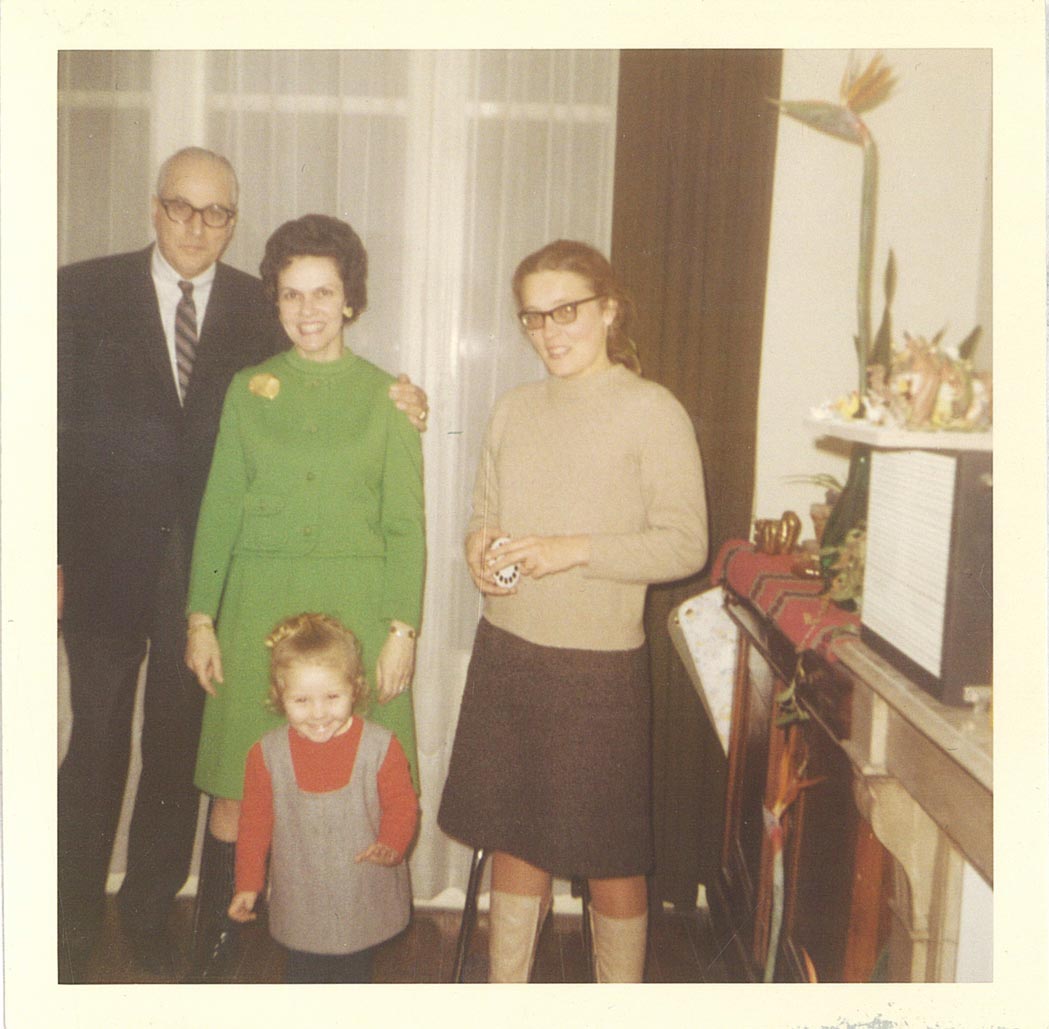
There was also the first solo exhibition at the Galerie Claude Bernard in Paris, and the first group show in New York at the Albert Loeb Gallery. The United States soon welcomed Ipoustéguy’s work in museums (such as the Guggenheim) and private collections. The Hirshhorn Museum bought a bronze copy of David and Goliath (1957). Ipoustéguy was impressed by the delicacy with which the “King of Uranium” — as he called him — conducted himself with his wife during his visit to Paris.
The Hirshhorn couple (on the left) with his wife, Françoise, and daughter Céline © Personal photo
1964-1966
Affirmation of an artistic singularity
He won the prestigious Bright Prize at the Venice Biennale for his sculpture Discours sous Mistra, which sums up his transition from the abstract to the figurative. The original idea dates back to 1944, when Ipoustéguy was working as a labourer at the Bordeaux submarine base. During a bombing raid, he entered the base. It was a revelation. A gigantic, teeming, enclosed world opened up before him. This sculpture takes its form from this scene.
From the 1960s onwards, Ipoustéguy asserted his aesthetic singularity in his works: “The three sculptures, La Terre, L’Homme and Discours sous Mistra mark an affirmation of Ipoustéguy’s vocabulary, his syntax, his formal patterns of predilection throughout his life. Volumes, protruding masses (…) contrast with staggered or superimposed planes, most often perforated, signifying depth, the immediate natural or artificial environment, and later shadow” *.
Then he had his first solo exhibition at the Albert Loeb Gallery in New York. Uncomfortable with openings and hating aeroplanes, he only visited the United States once, in 1997. He was impressed by the vibrant Big Apple, which immediately brought to mind Beethoven’s 5th Symphony. This trip enabled him to see in situ his work À la lumière de chacun, installed in 1982 in front of the French Embassy in Washington.
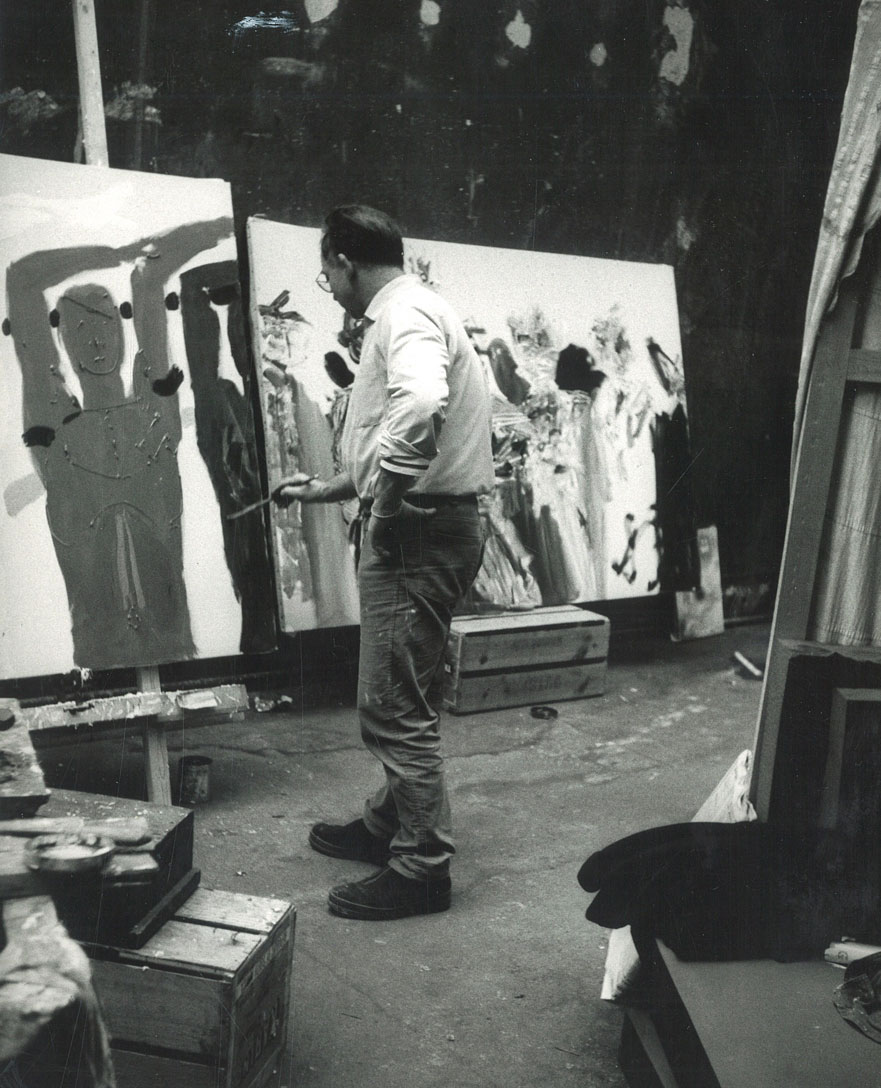
In 1966, Sam Szafran lent Ipoustéguy his studio on rue Crussol in Paris. For many months, he produced a series of impressive large-format canvases. This foray into painting was short-lived, as Ipoustéguy realised that he was first and foremost a sculptor and draughtsman.
* Pierre Gaudibert, Ipoustéguy, le Cercle d’Art, 1989
1968-1971
When Father and Mother invite themselves to the sculptural work
While working on a monumental work in marble, the continuation of a pictorial triptych entitled La Mort du Pape, his father died in February 1968. Ipoustéguy replaced the face of Pope John XXIII with Eugène Robert’s death mask, fulfilling a promise he had made to his father as a young man (“one day, I’ll make you into a pope!“).
The final work, La Mort du Père, was acquired by the National Gallery of Victoria in Australia. That same year, Choisy regular Bertrand Renaudinot, a documentary filmmaker, recreated in a short film the face-to-face encounter between Ipoustéguy-sculptor (he also represented himself in this ensemble) and his father’s memories.
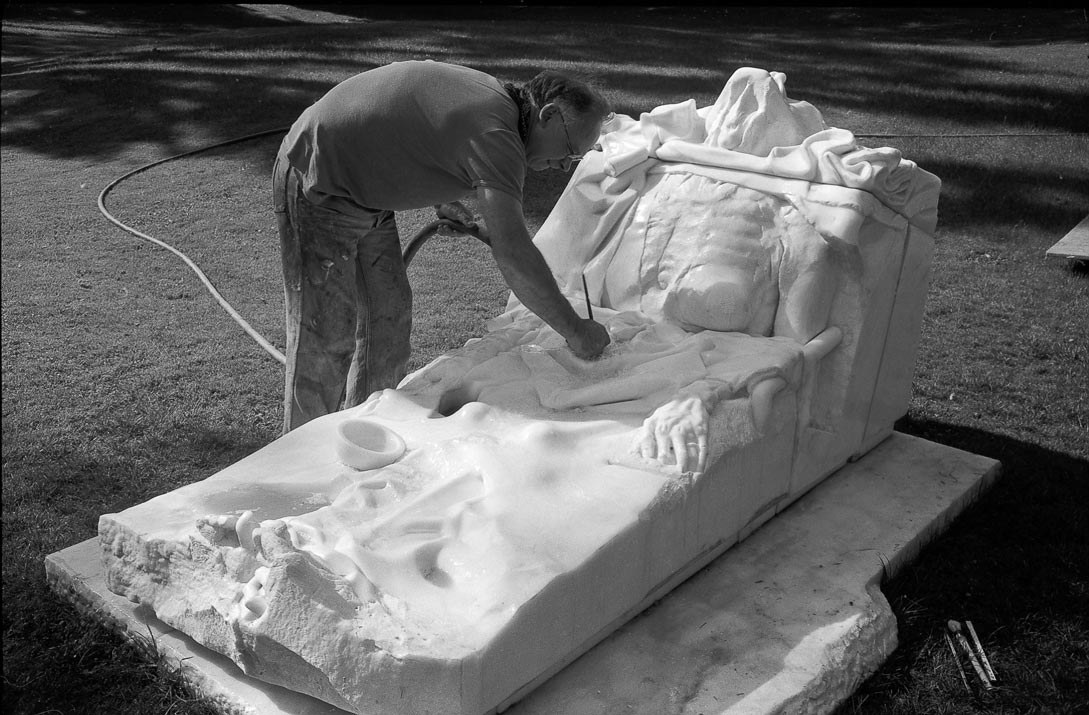
Intimate life, transfigured into more universal themes, is always present in Ipoustéguy’s sculpture. In 1971, he created L’Agonie de la mère, an impressive marble recumbent that depicts his mother’s final moments of suffering after she was diagnosed with breast cancer.
In front of Agonie de la mère © Despatin et Gobeli
Mai 68
The artistic and the political
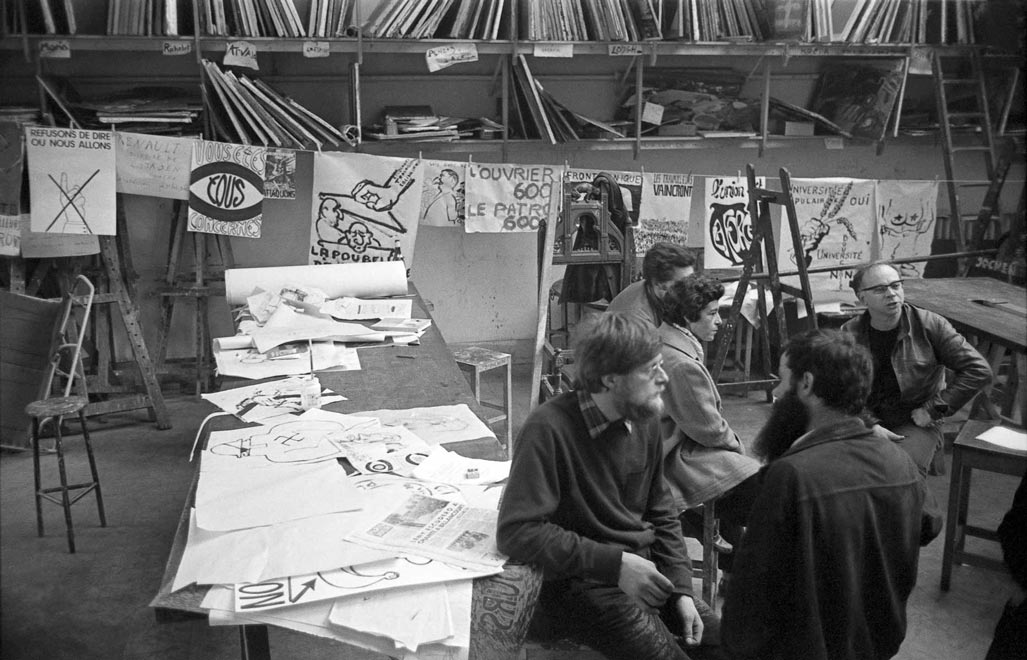
At the same time, the issues and demands raised by the May 1968 movement were echoed by Ipoustéguy. He produced a major series of lithographs – like political posters – at the Atelier Populaire des Beaux-Arts in Paris. An object book, Le Sirop de la rue (available for consultation, along with others, at Nancy’s Bibliothèque Stanislas) brings together most of these works.
In a completely different vein, very attentive to current events, which he avidly followed in the press, he was struck, in a Paris-Match photo, by the curvature of Olympic swimmer Kiki Caron’s legs. He would recreate this movement in the marble Les Plongeuses – a sculpture of her legs that the champion would admire years later at the Centre Culturel Ipoustéguy in Doulcon, Meuse.
In 1969, his second daughter, Marie-Pierre, was born.
Ipoustéguy at the Atelier Populaire des Beaux-Arts © Marc Riboud / Marc Riboud Collection at MNAAG
1970-1971
Intellectual ferment, creation and fame
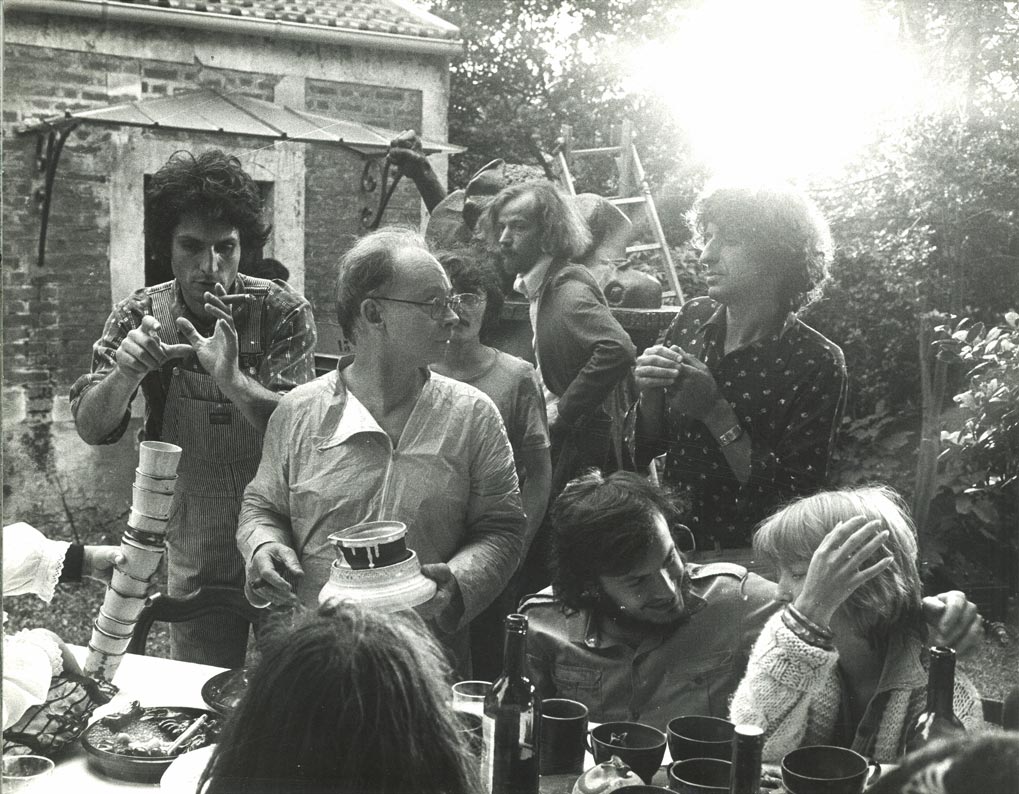
During the same period, his home-studio in Choisy became an open house for young people – artists or not – from all walks of life. Some, like Patrick Varnier, sculpted there, others photographed, like Despatin and Gobeli. André Glucksman and occasionally Patrice Chéreau were regular visitors. In 1972, the house even served as a “clandestine” printing press for La Cause du Peuple, a proletarian left-wing newspaper banned at the time (led by Serge July and a precursor to Libération). Ipoustéguy took part in this community life from afar, always preferring the calm of his workshop. Jacques Kébadian also began filming him at work (Ipoustéguy et son œuvre sculptée, Histoire d’une sculpture…). Some of these films were later produced by the young Marin Karmitz, who admired his work.
By the early 1970s, Ipoustéguy had gained wide recognition and exhibited extensively in France and abroad (Berlin, Copenhagen, Paris, New York, Rome, Darmstadt…). In 1971, he received his first public commission: L’Homme forçant l’unité, installed in front of the CNE in Grenoble.
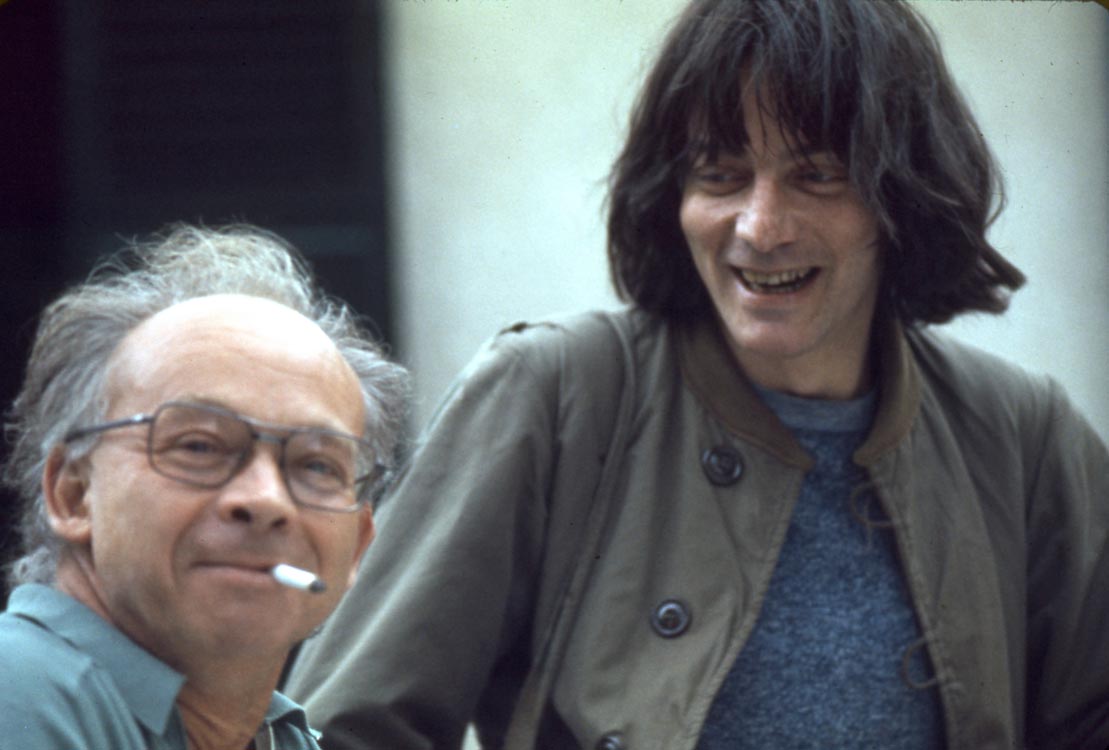
At Choisy, from left to right: Jacques Kébadian, Patrick Varnier, Bertrand Renaudineau © Despatin and Gobeli
1972
La Mort du Frère, a tribute to Pierre Overnay
At the request of André Glucksman, Ipoustéguy created a sculpture in tribute to Pierre Overney, a young Maoist worker killed by a Renault security guard in Boulogne-Billancourt. Ipoustéguy depicts the young man naked, fist raised, with a tray around his shoulders. On this tray lies the mutilated body of a young North African. Inspired by a drawing by Lucas Signorelli, he gives it power and heroism. As is often the case with Ipoustéguy’s work, it was poorly received by the committee, who saw it as a provocation rather than a tribute. He reappropriated this work, which became La Mort du Frère, one of the strongest and most political of his career. He altered the character’s sex and face, now concealed under a handkerchief, to make him anonymous – and therefore universal – so as not to embarrass the family.
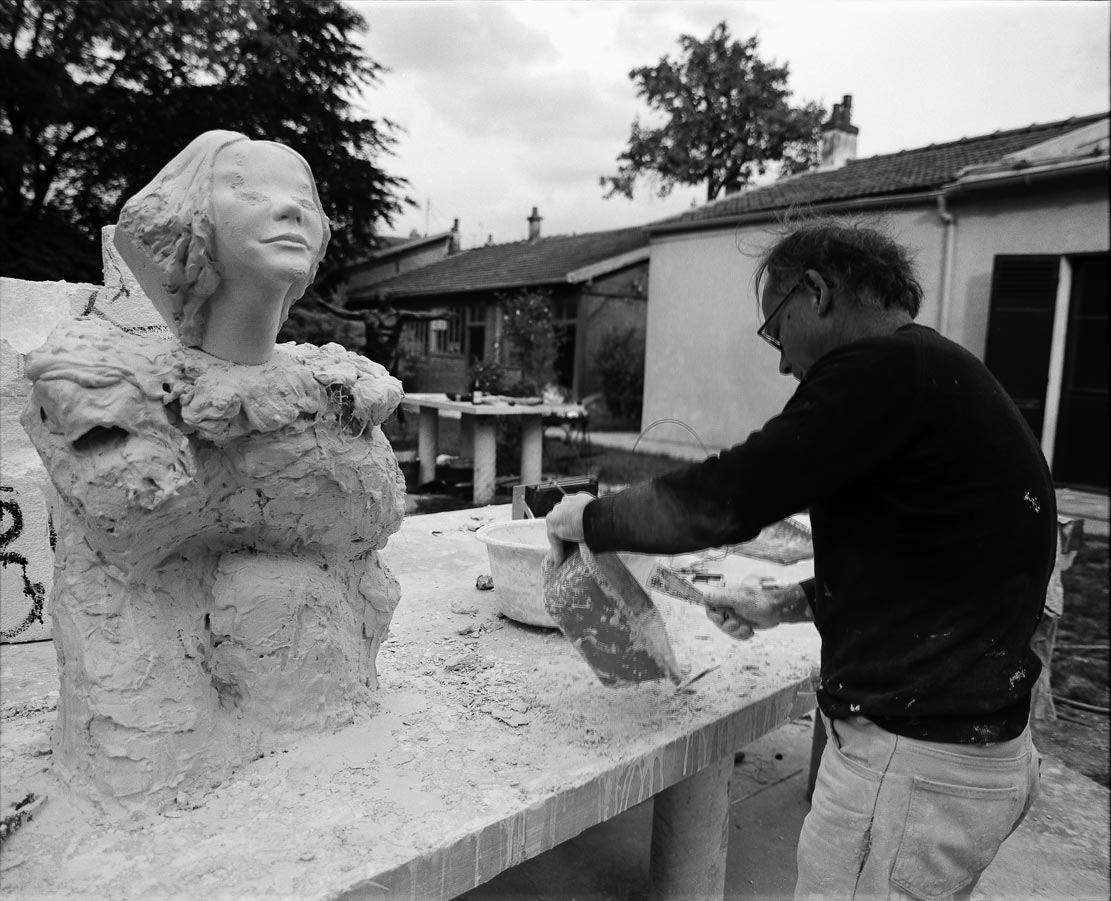
Ipoustéguy and André Glucksman in Choisy-le-Roi © Despatin and Gobeli
1974-1976
Ipoustéguy, the raw skinner
His eldest daughter, Céline, died suddenly. He was in Carrara when he heard the news and would never work in marble again. Two years later, his sculpture Scène comique de la vie moderne reflected this deep trauma and the violence of the shock caused by the news of her sudden death. As always with Ipoustéguy, the personal story is never presented to the viewer head-on. This is the mark of his great modesty, even if in this work he actually presents his self-portrait as a “flayed man”.
The childlike figure of his daughter appears the same year in another monumental work. In 1975, the Church of Philadelphia asked Ipoustéguy to take an interest in the future first American saint, John Neumann, canonised in 1977. Without particular constraints, he combined marble and bronze to depict the last moments of the Bishop, who died in the street to general indifference, apart from a young blind woman, here taking on the features of Céline. The work was not appreciated by the commissioner – with large institutions, Ipoustéguy was accustomed to it! “It lacked neon lights,” he mischievously concluded. It never crossed the Atlantic. Today, it can be admired in the Eglise Notre-Dame de Bonne Garde in Dun-Haut, Meuse.
In 1985, he began the monumental ” Jeunes filles ” series, a set of vignettes from everyday life, for the 20th birthday of his lost eldest daughter. For Ipoustéguy, it was a way to “prolong the destiny” of the girl who was unable to grow up.
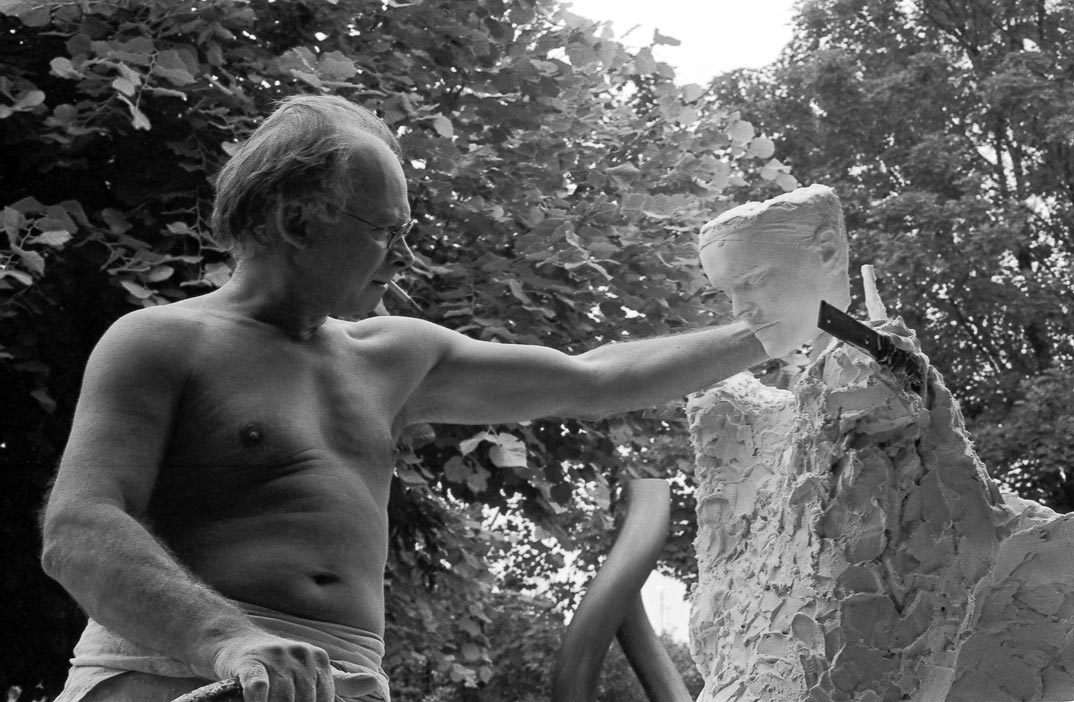
Working on Mort de l’évêque Neumann © Despatin and Gobeli
1977
Val de Grâce: art and its audacity in the face of conservatism
Ipoustéguy responds to a new commission, attracted by the specifications laid down by the military authorities: fraternity in helping the wounded. The sculpture was to bear the name of the hospital in which it was to take pride of place, the Val de Grâce. When the project was presented the tension was palpable. One officer dared to declare that this type of artist should be “kicked out on his ass”. What had disturbed them so much? The depiction of a naked wounded man? The ‘too-feminine’ head (actually made from a cast)? The indignation of the Ministry of Culture representatives Michel Troche and Bernard Anthonioz, who would always support the work, caused them to leave the meeting. The sculpture was finally installed in the hospital hall, thanks to the intervention of the Minister of the time, Charles Hernu *.
The often violent rejection of his work did not prevent Ipoustéguy from gaining recognition both abroad and in France. In 1977, he was awarded the Grand Prix National des Arts.
*The sculpture is now at the Hôpital Percy (Clamart 92) following the closure of the Hôpital du Val de Grâce. See map of works in Île-de-France.
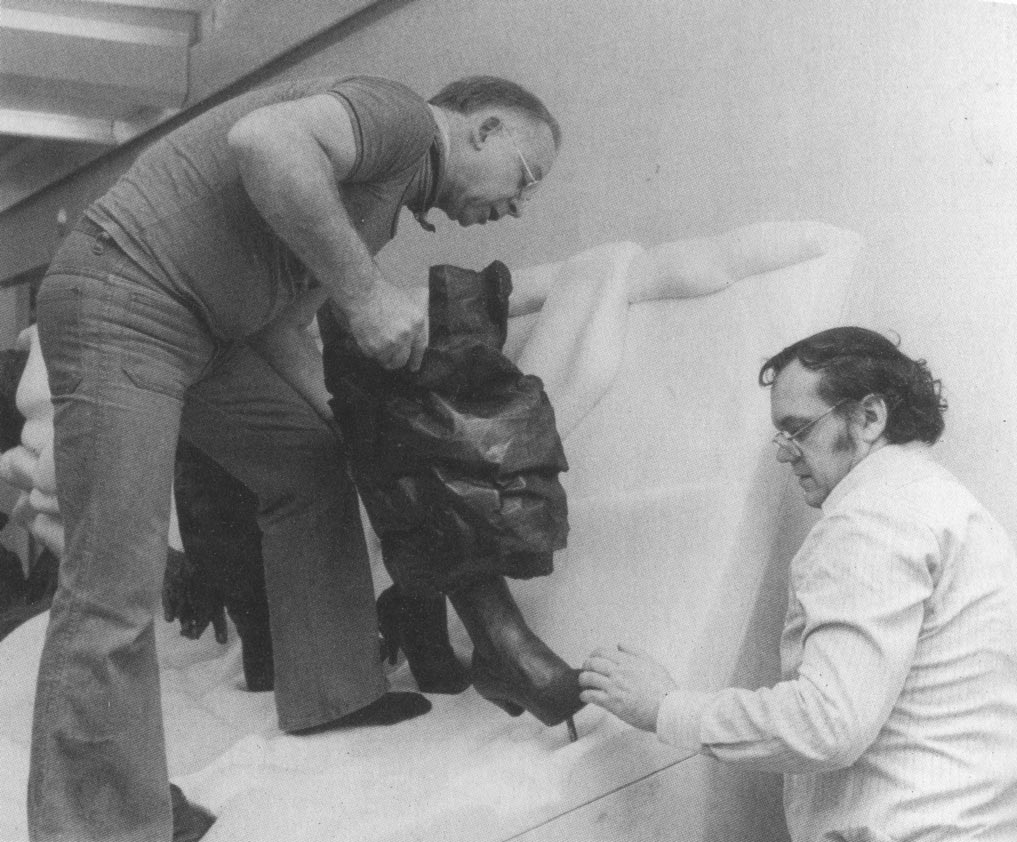
Ipoustéguy facing the Val de Grâce © Despatin et Gobeli
1978
Public recognition on both sides of the Rhine
In 1978, the Fondation Nationale des Arts graphiques et plastiques organised its first retrospective on rue Berryer in Paris. Photographers Despatin and Gobeli – who had their photo lab in Choisy and often followed “Ipous” on his many travels – captured the presentation of some fifty sculptures and as many drawings. This exhibition secured his recognition in both the mainstream and specialist press.
An equivalent presentation in Berlin, orchestrated by Dieter Ruckhaberle at the Kunsthalle the following year, cemented the connection between Ipoustéguy and Germany. Indeed, it was a German historian, Michaël Lipp, who, under the direction of Professor Hans-Jürgen Imiela, wrote the first thesis devoted to Ipoustéguy’s work in 1992, available here.
With Dieter Ruckhaberle © All rights reserved
1979
"Ecbatane's" odyssey to Berlin on a grand scale
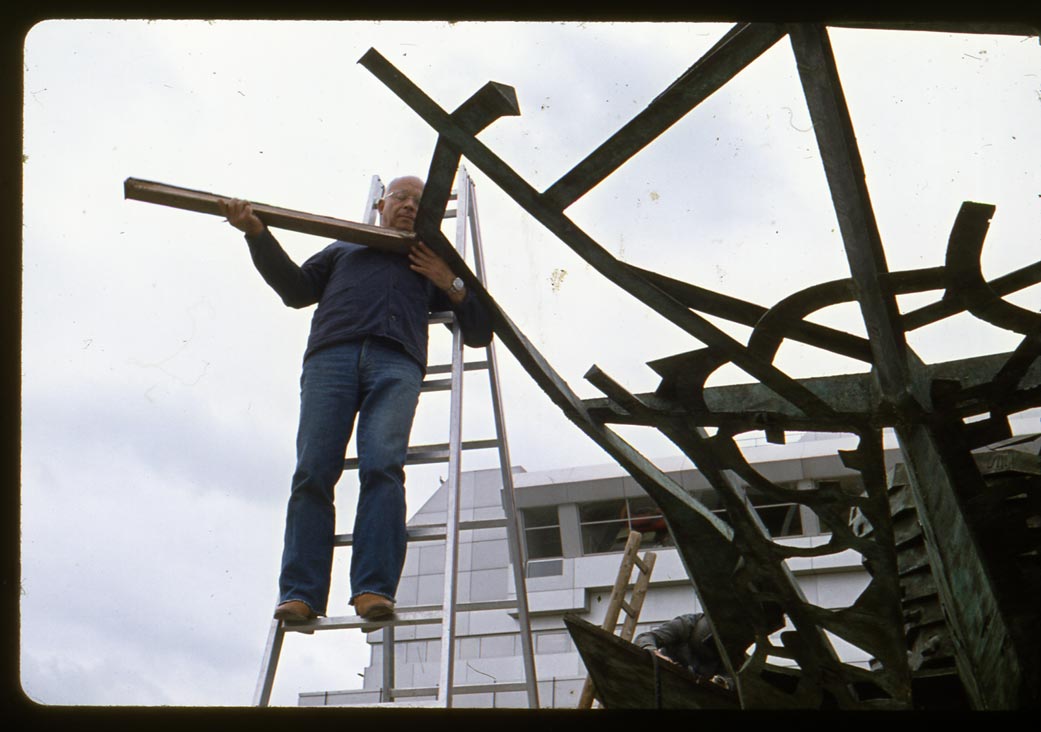
Another German adventure, the craziest yet. In 1978, Ipoustéguy won a competition organised by the Berlin Town Hall. The result was L’Homme construit sa ville, a monumental sculpture (” the largest ever created by a single man”, he says) installed in front of the Palais des Congrès. From the creation of the work – a fourfold enlarged and redesigned replica of Ecbatane – to its casting in Italy and transportation to West Berlin, it was a veritable epic. This journey, which culminated in a hunger strike due to difficulties in getting paid, is filmed in Histoire d’une sculpture by another great Choisy-le-Roi regular, director Jacques Kébadian.
Constructing L’Homme construit sa ville © Despatin and Gobeli
1981
Shadows take over the work
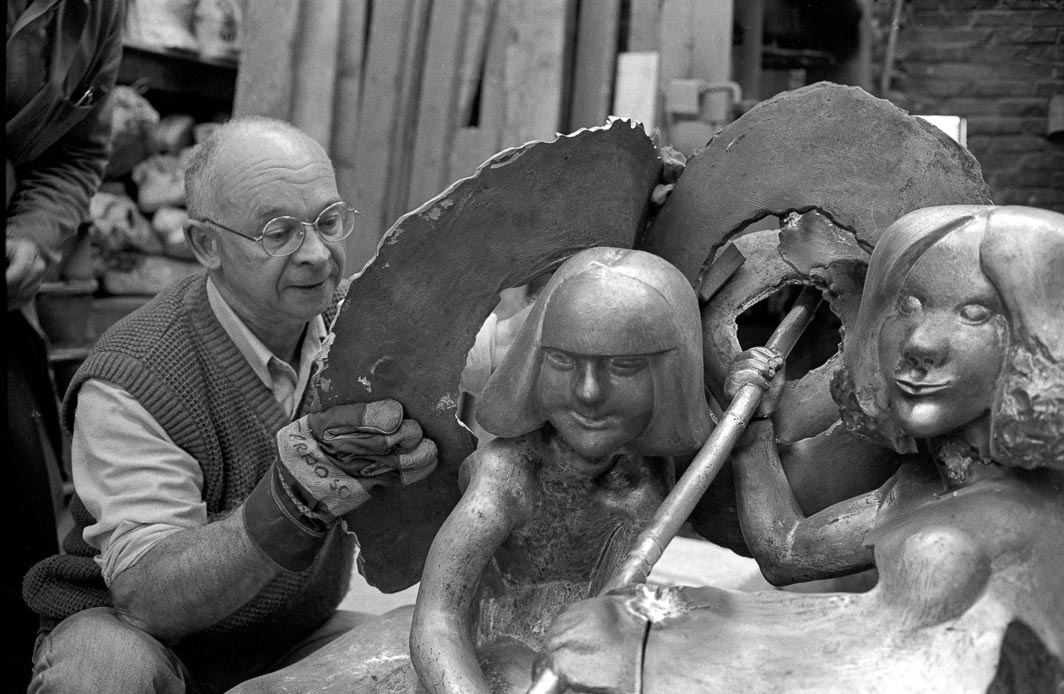
The 1980s marked an aesthetic turning point in Ipoustéguy’s career. In 1981, he created four monumental ensembles for Place Louis Pradel in Lyon, including Louise Labé (“the great pivot of my work”), which was the first to integrate shadow into his sculptures. Seeing shadow as “inalienable” from beings or objects, he began representing his subjects alongside their shadows in tangible form. Ipoustéguy sculpted this “belle cordière,” over 3 meters tall, using a makeshift scaffolding built outside. Despatin and Gobeli’s short film, Dans mon jardin, j’ai vu mon ombre, captures the artist at work with insightful commentary by Jeanne Fayard, read by actor Marcel Bozonnet.
During his frequent TGV trips between Choisy and Lyon, he wrote his childhood memories “from zero to thirteen” in Chronique des jeunes années.
Actor and director Marcel Bozonnet—a regular at Choisy—performed Marie de l’Incarnation, a play based on the 17th-century correspondence of Marie Guyart. Ipoustéguy created a series of watercolours inspired by the performance and the solo presence of the actor on stage.
With his two daughters in bronze for the fountain at Place Louis Pradel in Lyon © Despatin et Gobeli
1982
Nature and Simplicity
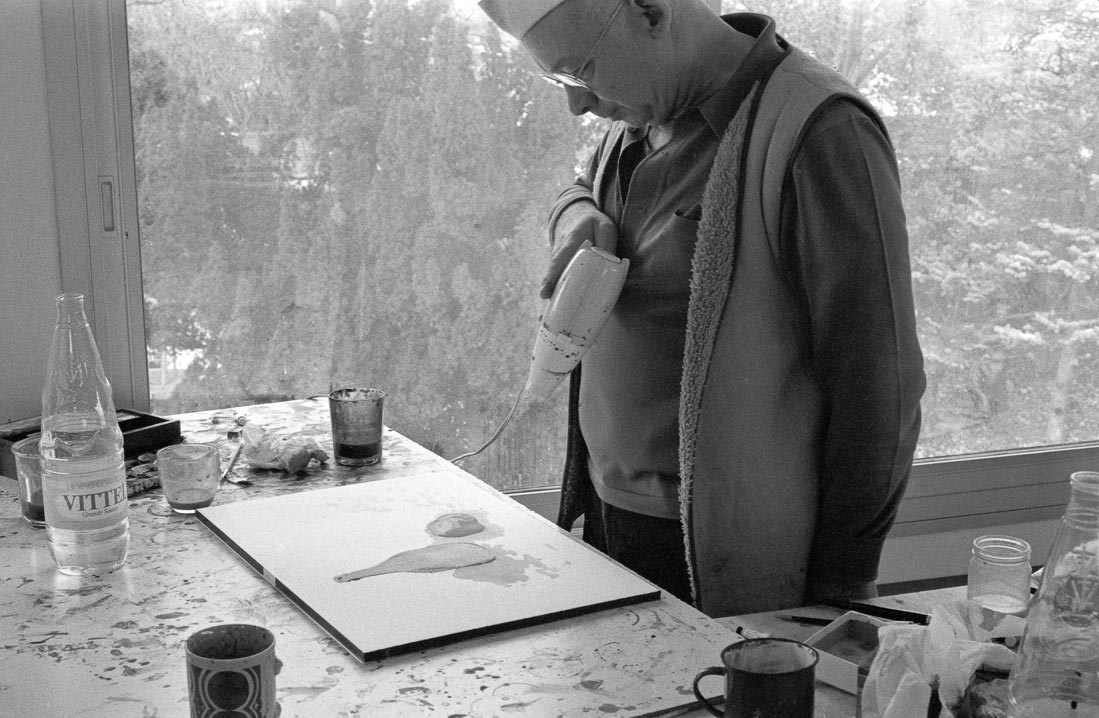
With Louise Labé, Ipoustéguy abandoned anatomical studies and shifted toward more primal forms. He began sculpting fruit, even though he had previously dismissed them for their sheer simplicity. Still lifes, in watercolour or bronze, became the major focus of the early 1980s. In doing so, he came to embrace a nature he had thought he disliked.
Drying watercolour in his Choisy-le-Roi studio © Despatin and Gobeli
1983
Independence and recognition
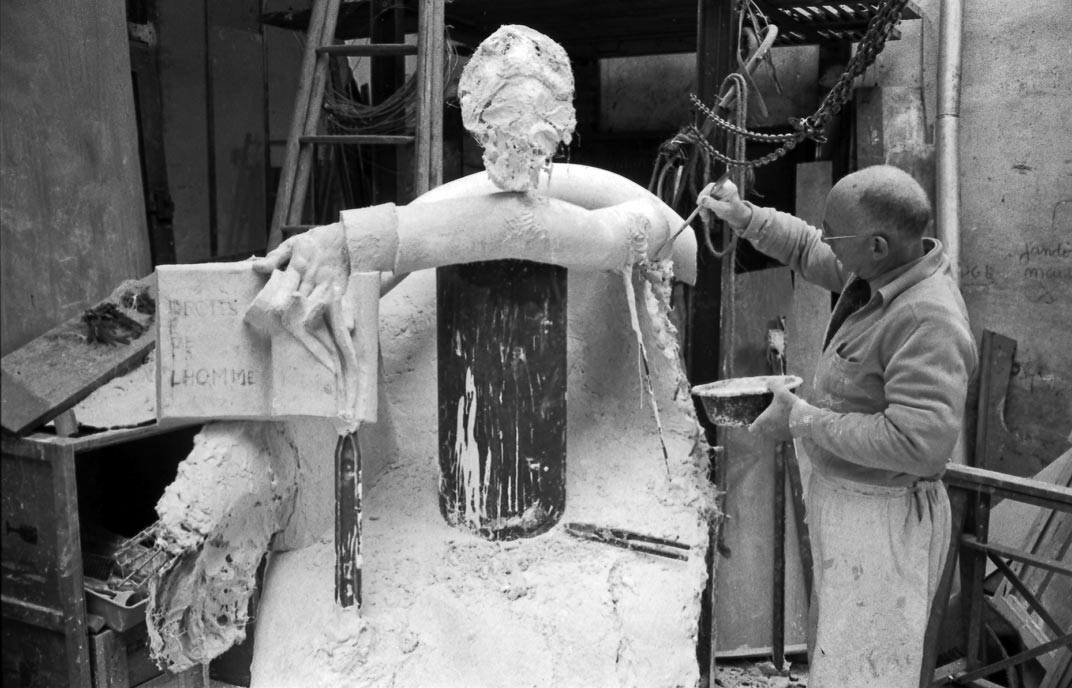
He was commissioned by the French Ministry of Foreign Affairs. A la lumière de chacun commemorates the bicentennial of American independence on September 3, 1983. It is installed in front of the French Embassy in Washington. The following year, Ipoustéguy was awarded the Légion d’Honneur by Jack Lang.
A la lumière de chacun in the studio © Despatin and Gobeli
1984
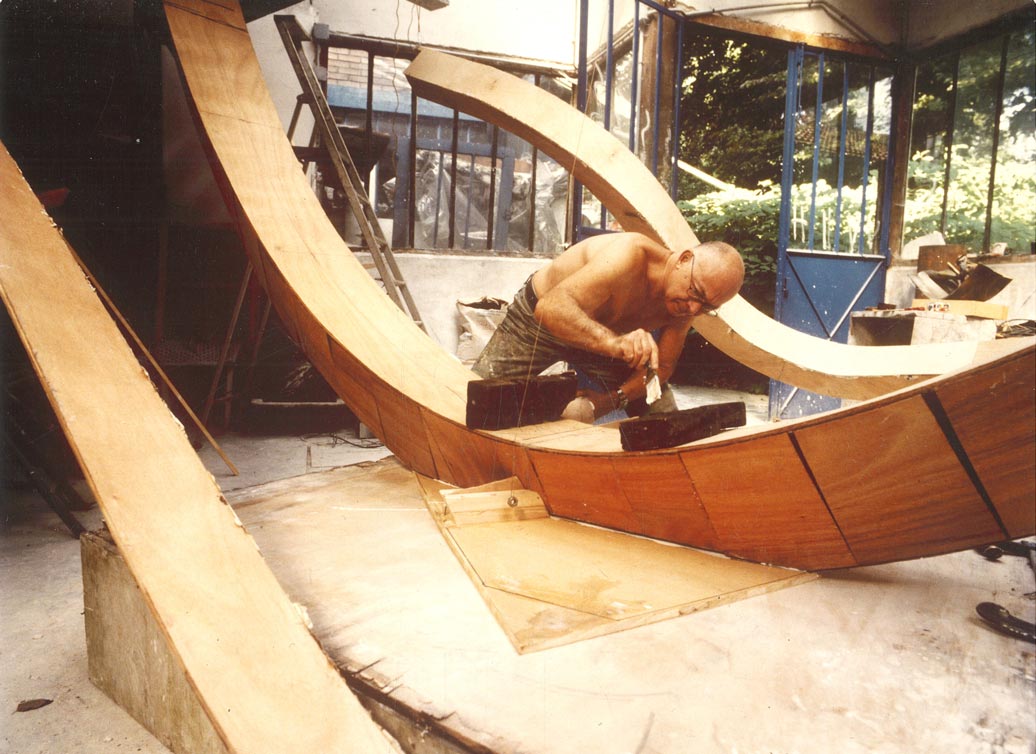
The Poet, the Sculptor and the President
French President François Mitterrand commissioned Ipoustéguy to create a sculpture of the poet Rimbaud: L’homme aux semelles devant. Ipoustéguy embraced the subject, both out of love for the work and fascination with the figure who literally split his life in two: precocious poet and later arms dealer. A few years later, he co-authored a tribute with the young academic Bertrand Tillier, Rimbaud, l’enfant lettré.
The title (a wordplay, which the poet loved, was rejected) and the execution puzzled many: the 1988 installation faced heavy criticism in the press. Added to this was the administration’s stubborn refusal to pay him (“we don’t know why your name is systematically rejected at the bottom of the list by the computer,” he was told). Outraged, his supporter Louis Clayeux arranged a meeting with President Mitterrand, who was behind a fence observing the simulation of the future Louvre pyramid: “When I arrived, he looked at me scornfully… the next day, I was paid.”
Today, far from controversy, this sculpture is installed on the banks of the Seine, in the Tino Rossi gardens. There, it joins Hydrorrhage, another sculpture admired by Parisian passersby.
With the boat of Rimbaud, L’Homme aux semelles devant © All rights reserved
1988-1989
A la Santé de la Révolution celebrated by Literature and Cinema
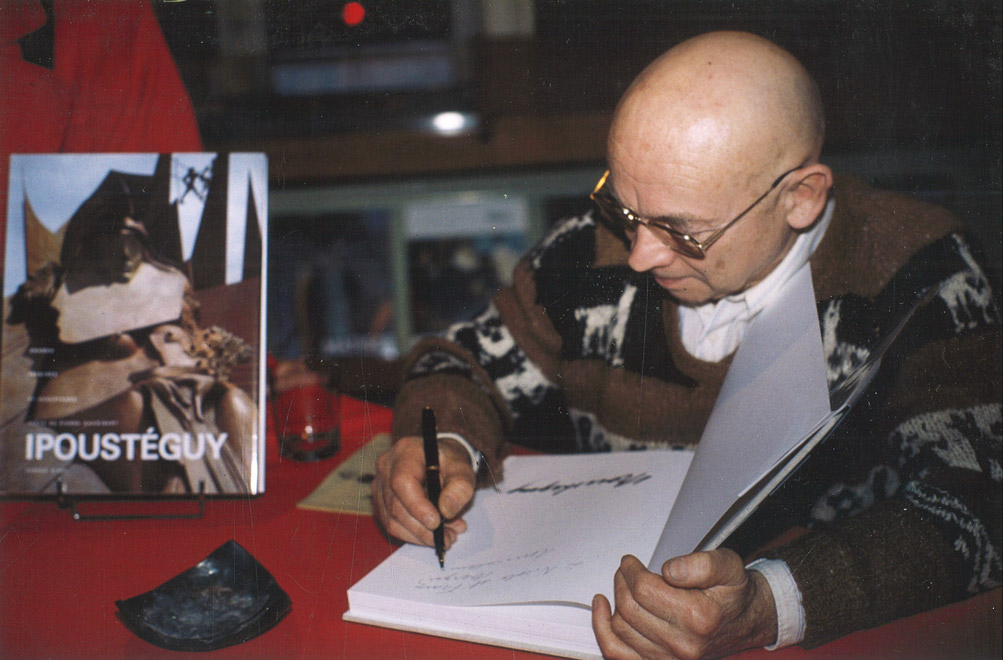
In 1988, he created a monumental ensemble in Bagnolet: A la Santé de la Révolution. Unlike the reception of his Rimbaud sculpture in 1984, it was met with enthusiasm. The subject appealed to him—“the Revolution escapes the institution”—as did its setting in the popular gardens of Parc de Bagnolet. Some of the large bronze needles representing Liberty, Equality, and Fraternity (the “Bagnolettes,” as he called them) watch over the figure of the Republic, glimpsed in a few shots of Le Nom des gens, a film by Michel Leclerc (2010).
A la Santé de la Révolution graces the cover of the Ipoustéguy monograph published the following year by Cercle d’Art, with texts by Pierre Gaudibert, and includes a first interview with Evelyne Arthaud. In 1993, a longer interview became a book in which Ipoustéguy reflects on his life and work, Ipoustéguy, parlons… In 1989, American author John Updike published an essay on art, Just Looking, which features a lengthy article (“La pulsion vitale”) devoted to Ipoustéguy. Updike later sent an admiring letter to the artist’s family upon his passing.
Also in 1989, he traveled to Celle, Germany, accompanied by his friend and painter Rainer Mordmüller, who served as his interpreter, to receive the Heitland Foundation Prize. On this occasion, the town installed Homme passant la porte (1966) and Lecture (1985) in public spaces, where they remain visible today.
Dedication of the Cercle d’Art monograph © Photo René Lanaud
1995
Eros and Thanatos!
In 1995, a former schoolteacher, Robert Desnos, researching famous figures from Dun-sur-Meuse, discovered Ipoustéguy. This prompted him to return to his childhood haunts. He built connections with the Dun-sur-Meuse community, led by Jeannot Lambert, and with the Meuse Department under Jean-Pierre Hélas, who welcomed him warmly. Homme passant la porte (1966) and Discours sous Mistra (1965) have since greeted visitors at the Hôtel du Département in Bar-le-Duc.
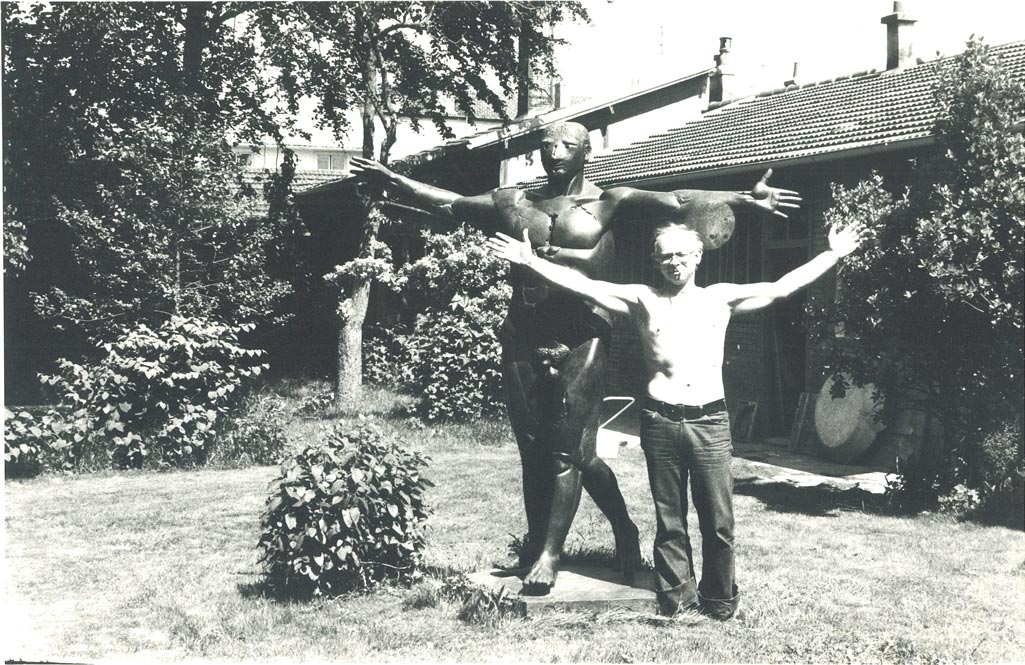
The same year, he faced his first serious health scare: a heart attack and hospitalization. He underwent multiple surgeries (“opened like a lobster”) and became friendly with his surgeon. One Sunday in Choisy, the surgeon paused in front of the sculpture Homme (1963) and realized that the torso cuts mirrored the ones he had made on his patient.
In response to this sudden closeness to death, Ipoustéguy created a series of erotic sculptures using recycled materials. The execution was so explicit that it made his close friend Jean Moreau—a journalist at Nouvel Observateur—blush when the works were moved to Galerie Valois for exhibition.
Eroticism is a central theme in Ipoustéguy’s oeuvre, alongside death. This was highlighted in the posthumous retrospective Ipoustéguy, Eros + Thanatos, organised by Flavio Arensi and Pascal Odille at Palazzo Leone in Legnano, Italy, in 2008–2009.
During the 2020 Centenary, organised by the Département de la Meuse, many of these works were also featured in the exhibition Les Erotiques, which was filmed.
In front of Homme © Photo Walter Lewino
1997-1999
In the spotlight at prestigious exhibitions in Paris, London and Berlin
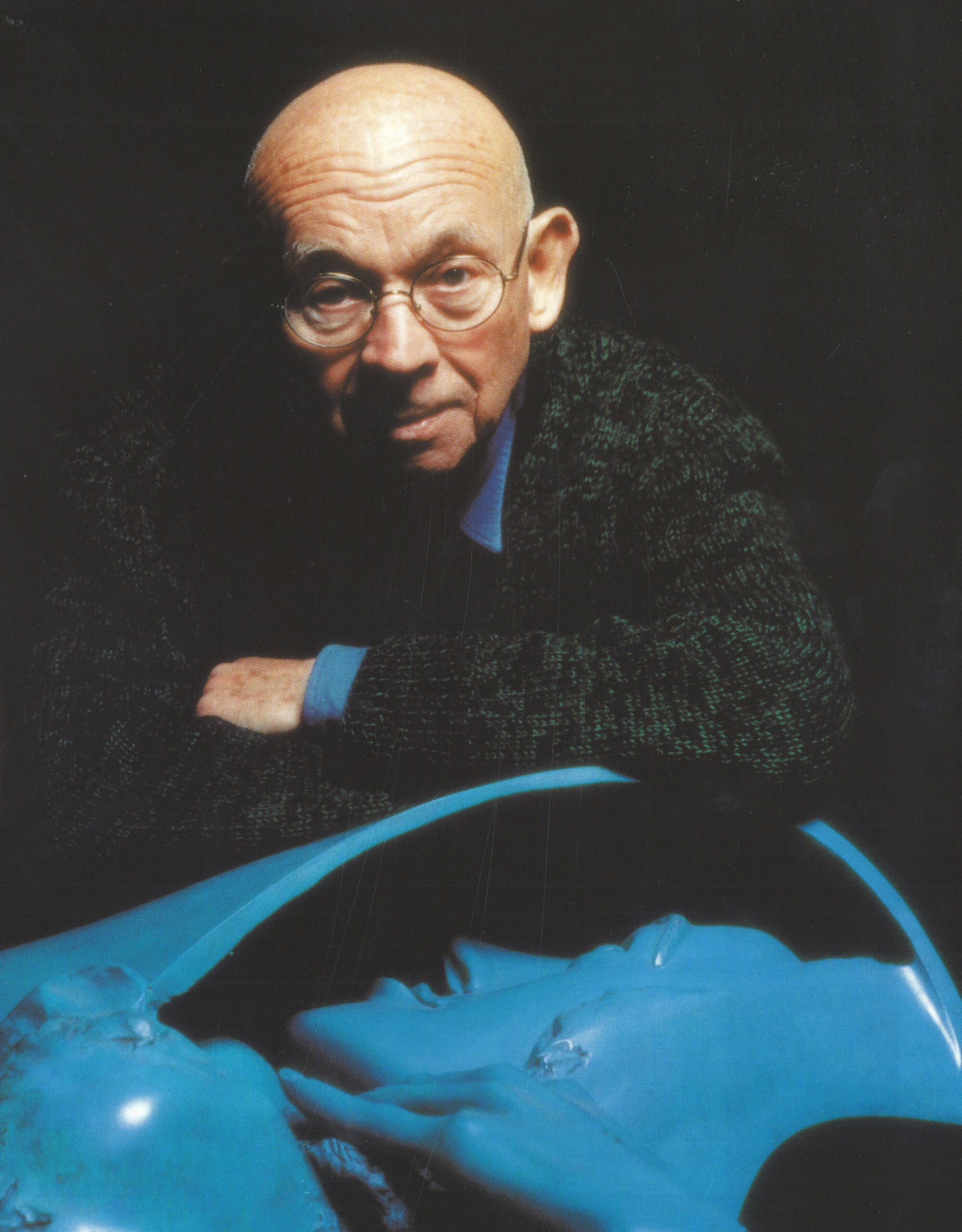
The Made in France exhibition opened at the Centre Pompidou, designed and curated by Germain Viatte, Director of the Musée National d’Art Moderne – Centre de Création Industrielle. The exhibition offers “a free and multidisciplinary reading of French creative activity over the past fifty years,” as stated in the brochure. The sculpture Ecbatane was featured as part of this presentation of contemporary French artists.
The following year, a magnificent retrospective titled Head, Hand and Heart was organized by the Royal British Society of Sculptors at Chelsea Harbour, London.
1999 was also the year he completed his last monumental work, Porte du ciel, installed in Braunschweig, Germany.
Head, Hand and Heart exhibition poster at Chelsea Harbour © All rights reserved
2001
The Meuse at the heart
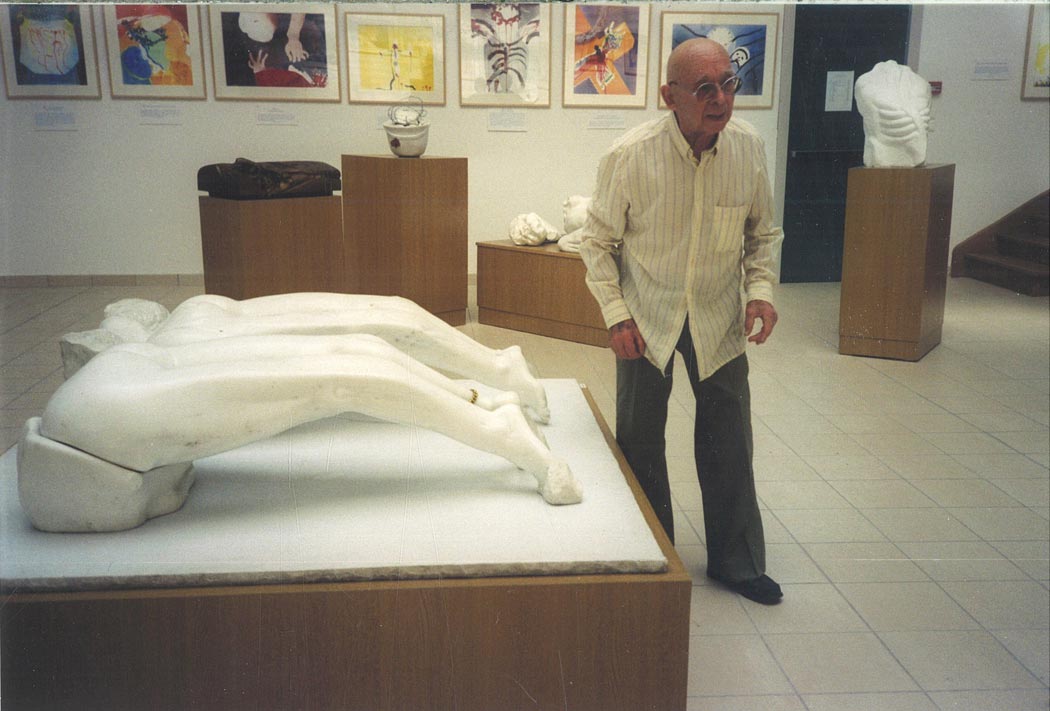
In Ipoustéguy’s hometown, the “Centre Culturel Ipousteguy” (“definitely not a museum, that makes it look like a mausoleum…”) was inaugurated. It holds some of his works, including a replica of Louise Labé and a bronze version of Val de Grâce. The astonishing Mangeur de Gardiens (1970), made entirely in ceramic, has been added since 2021.
In 2001, the catalogue raisonné of his oeuvre, compiled by academic Dominique Croiset-Veyre, was published by Éditions de La Différence. It documents all of the artist’s sculptural works, along with photographs and texts.
Ipoustéguy in the Ipoustéguy Gallery at the Centre Culturel du Val Dunois © Personal Photo
2003-2006
Testimony to an artist's life
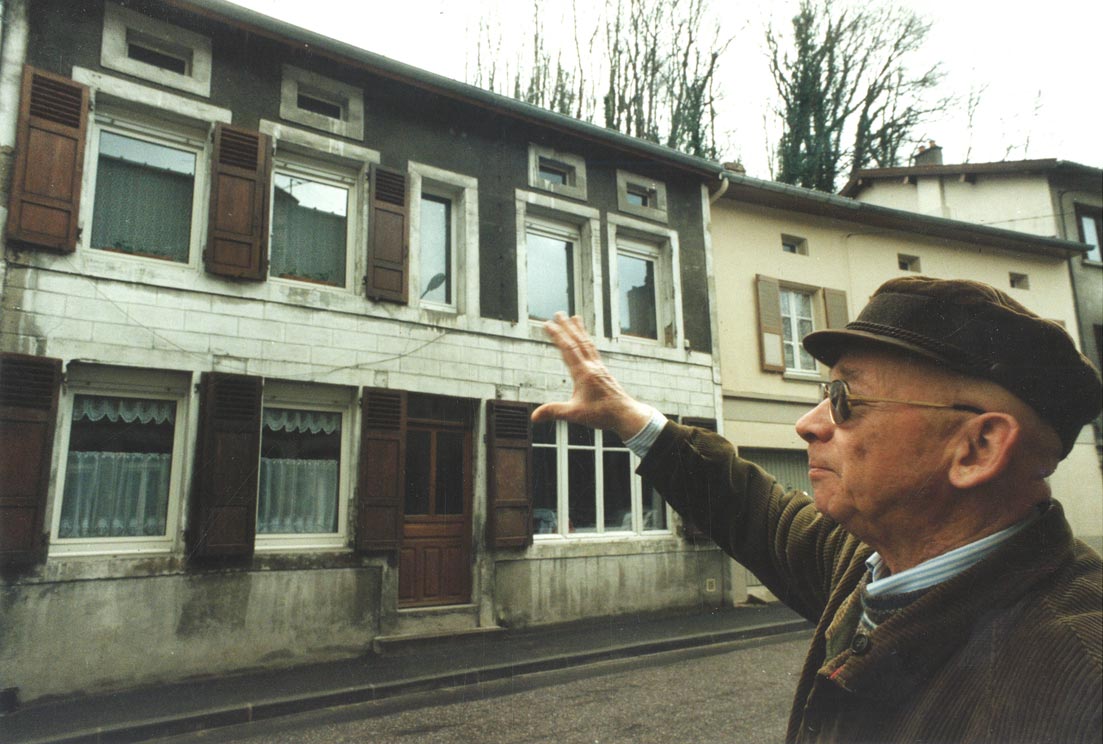
In 2003, he left Choisy-le-Roi and moved to his birthplace, aiming to prepare his legacy. The documentary Ipoustéguy, the Man Who Moves traces the relocation of the artist and his works to Lorraine.
In 2005, he gave a long interview with Jean Daive, Surpris par la nuit, on France Culture.
That same year, the Département de la Meuse and Serge Domini published Ipoustéguy sculpteur, collecting texts by Françoise Monnin, editor-in-chief of Artension magazine, and photographs by Jacques Guérard.
He passed away on the morning of 8 February 2006, in front of his coffee and window, at the age of 86.
Ipoustéguy in front of his birthplace in Dun-sur-Meuse © Personal photo