
Ted Gott, “The Death of the Father at the National Gallery of Victoria”
Art Journal 59
Jean Ipoustéguy’s Death of the Father at the NGV: Marble, Metal and Lots of Ink
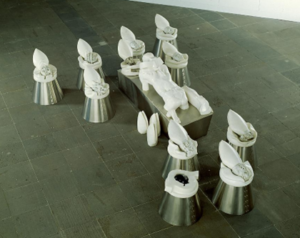
In October 1972, Annette Dixon, curator of European and American art after 1800 at the National Gallery of Victoria, was brimming with enthusiasm. At thirty-four, she had enabled the institution to make its most significant acquisition to date using funds from gallery admission fees. It was Jean Ipoustéguy’s Death of the Father, a six-metre-long, multi-part installation in marble, bronze and stainless steel, arranged to resemble the floor plan of a basilica. It depicted the narrative of the physical decline of a paternal figure allegorised in the clergy, witnessed by the crouching son-sculptor, whose erect penis pulsed with vital force. “I fell in love with this work,” Dixon told a journalist from The Herald. “It is passionate. It is sensual. It is erotic. It asks to be touched.” [1]
The acquisition of this imposing and monumental sculptural ensemble had been under negotiation for more than a year, since Dixon had first recommended it in early 1971. Ipoustéguy’s dealer, Claude Bernard Haim in Paris, had initially asked $85,000 for the work, of which Dixon had seen photographs in one of his catalogues. After Melbourne art dealer Georges Mora interceded on behalf of the NGV and inspected Death of the Father at Haim’s private residence, La Besnardière, near Tours in central France, the price was negotiated down to $60,000. Still a considerable sum. Dixon’s acquisition proposal to the NGV trustees in February 1972 stated: “This is without doubt the most important work Ipoustéguy has created to date and one of the greatest sculptures produced over the last decade.” [2] That the acquisition of Death of the Father was not without its difficulties seems to be indicated by Dixon’s subsequent admission that “[i]t required a great deal of discussion – believe me, the acquisition was no small feat – and the trustees eventually agreed.” [3] Even the letter of support that Melbourne sculptor Lenton Parr, then director of the National Gallery of Victoria Art School, provided for Dixon’s acquisition was phrased in ambivalent terms. Noting that the work “would offer a remarkable insight into the metaphysical symbolism of contemporary sculpture of the human figure,” Parr could not help but frankly declare that “Ipoustéguy is a bold artist whose style is too histrionic for some tastes, including, it must be admitted, my own.” Nevertheless, he concluded: “However, in this major work, the expressive means are sustained by the scope of the theme and the result is most impressive.” [4]
Contemporary sculpture in Melbourne at that time, including Parr’s own, consisted primarily of modernist and abstract steel constructions experimenting with “burnished, polished, often brightly painted and welded industrial forms” (although some artists, such as Les Kossatz and Peter Corlett, were still working figuratively). [5] The NGV’s new premises, designed in a resolutely modernist style by Sir Roy Grounds, had only opened a few years earlier, in 1968. The building had a clean aesthetic that saw most “old-fashioned” nineteenth-century narrative paintings banished from its walls, cast into the basement for decades in an area gallery staff called the “elephant depot.” In this climate, the NGV’s acquisition of a sculptural ensemble composed primarily of hand-carved Carrara marble and imbued with both religious and Renaissance-evocative symbolism could only cause a sensation. It is therefore unsurprising that the first public presentation of Death of the Father in Melbourne in October 1972 “saw the art world erupt in total controversy.” [6]
The sculptor was born in 1920 in Dun-sur-Meuse, in north-eastern France. He was the son of a French carpenter, Eugène Robert, and a Basque hairdresser, Madeleine Ipoustéguy. He spent his youth wandering the countryside near Verdun, the site of intense fighting during the First World War, where the earth was still scattered with funnel-shaped forms marking shell impacts.
“We were surrounded by the remnants of war,” he later recalled. “Walking on the ground, I realised I was treading on death.” [7] The theme of bodily decomposition would, unsurprisingly, go on to influence his artistic practice. In 1937, the family moved to the Paris suburbs where, a year later, after taking the wrong bus, the young Ipoustéguy stumbled by chance upon the school where the City of Paris offered free evening drawing classes. He enrolled to study under Robert Lesbounit. These studies were interrupted by the outbreak of the Second World War, when he was mobilised into the army, eventually finding himself in south-western France as a metalworker during the Vichy regime. After the war, returning to the evening classes in Paris, he received the first prize in drawing in 1946. Lesbounit then encouraged him to abandon his birth name, Jean Robert, and adopt instead, as his artist name, his mother’s maiden name.
When Ipoustéguy discovered his vocation as a sculptor, he faced an immediate obstacle. He summarised the situation:
It so happened that when I began to sculpt, the spirit of the times and fashion excluded the human figure from art. In the 1950s, to circumvent the language of “the abstract,” I took my own path: I sculpted cities, architectures, masses traversed by voids, which inscribed themselves geometrically in space. It was a way of learning my form and resisting this pressure, this prohibition on representing the body. [8]
A trip to Greece in the early 1960s, where he studied ancient Greek sculpture, consolidated his commitment to exploring the human body in his art, which was now inspired by mythological and historical narratives in a series of large-scale bronzes. In August 1967, he travelled to Carrara in central Italy, a region whose quarries had been renowned for the quality of their marble since Roman antiquity. He was fascinated by Michelangelo’s use of this marble for his iconic High Renaissance sculptures such as La Pietà, 1498–1499 (St Peter’s Basilica, Vatican City), and the colossal David, 1501–1504 (Galleria dell’Accademia, Florence). He was also intrigued by the fact that the use of this marvellous material in the twentieth century had largely been reduced to the production of cemetery memorial monuments and interior tiling. Ipoustéguy spent a year working with the marble sculpture workshops Laboratori Artistici Nicoli, perfecting his mastery of direct carving in marble. Many years later he recounted:
“In Carrara, I immediately succeeded, creating something worthwhile straight away. I have never had a problem with materials. I have always had a connection with them, I have experienced something. I speak with metal, which tells me: You’re on the right track, go for it. And I listen to marble. When the carving is right, I hear: yes, yes.” [9]
While Nicoli’s assistants roughed out the blocks he chose from the quarry, he always worked alone to bring forth from within them the sculptures he imagined, exploring the possibilities of marble and releasing its translucent effects through direct carving with his own hands. [10]
The first work Ipoustéguy created at Carrara was Death of the Father, a vast installation composed of seventeen distinct elements which, together, recount an ambiguous scenario of devotion, decomposition and Oedipal tension. At the centre of this tableau, described in the artist’s own words:
“the father lies on his back, his face and hands in silvered bronze, receiving the marmoreal presence of the son who, with a restraint around his neck, is suspended in an aggressive pose above him. He is surrounded by about ten mitre-capped papal heads, their faces compressed or disfigured, their shoulders.” [11]
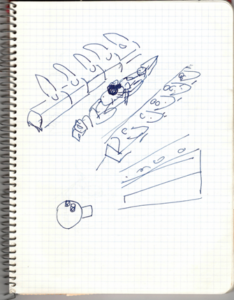
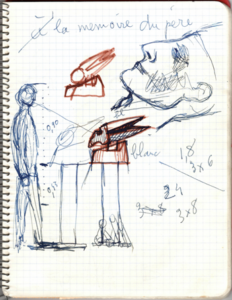
The central figure of the son is sculpted with a Michelangelesque sensibility. He is depicted crouching over his father’s coffin, whose cold metallic form resembles a mortuary operating table. He stares fixedly ahead, towards the father’s realistic face and hands, around which radiate a series of faces in progressive states of decomposition, the last reduced to a perforated ball in dark steel. A nod to contemporary abstraction, these are placed on smooth stainless steel cones that are “sutured” together, as after an autopsy, beneath the neck. Their arrangement around the perimeter of the installation has been compared to the forms of the pleurants, mourning figures who surrounded the central effigy of the deceased in Burgundian funerary monuments of the fourteenth and fifteenth centuries (a sketch of the installation is composed in this manner). The repeated, glinting mitres placed atop these skulls punctuate the piece like bursts of baroque trumpet.
Reflecting on his unique figurative style, Ipoustéguy declared:
“I place myself somewhere between the baroque, with its volcanic contours that distribute light and shadow equally across the sculpture, and classicism, which eliminates shadow from its volumes as much as possible.” [12]
As American writer John Updike put it:
“Determined to restore to sculpture its pre-Brancusi complexity, Ipoustéguy draws on virtuoso resources that recall the baroque masters, with their exuberant mixtures of materials (metal, stone, marble colours) and their ambitious assemblages of groups and entire environments.” [13]
The elegiac yet disturbing funeral procession of decomposing heads arranged around the central figure of Death of the Father has been compared to “a field of corpses”; while the viewer is unsettled upon realising that the marble leg, to the right of the son’s muscular but distorted torso, does not belong to him, but to another, still veiled, entirely different entity. [14] “Even if my work is ambiguous,” Ipoustéguy declared in 1978:
“I express something that we all have and that is profoundly unknown, that eludes analysis. I bring forth the unknown, which belongs to everyone, which awakens, which provokes human unease. It is also what often displeases, what seems intolerable [in my work], and not nudity, immodesty or violence. There is something else behind it.” [15]
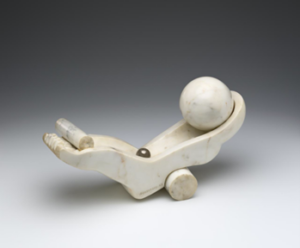
Death of the Father was first exhibited at the Galerie Claude Bernard in Paris in November 1968. It was included in a solo exhibition devoted to works the artist had hand-carved at Carrara between August 1967 and September 1968. Another work from that exhibition, Chistera, 1967, was subsequently donated to the NGV in 1993. The exhibition catalogue contained detailed photographs of Death of the Father and an impenetrable text by French philosopher André Glucksmann. This catalogue was made available to NGV visitors in 1972, but only in the original French version, as Glucksmann’s text “proved difficult to translate accurately.” [16]
After visiting the 1968 Paris exhibition, critic Paul Waldo Schwartz wrote:
“Jean Ipoustéguy’s performance at the Galerie Claude Bernard is a remarkable incursion, a magnificent indiscretion… The exhibition is all Carrara marble and induced in a Renaissance light that is strictly taboo, as Ipoustéguy knows very well… The conception is theatrical, but also so in a magical sense, for the image of flesh that Ipoustéguy carries to taut extremes has become, with time, both revelation and shock. And a challenge. It is there less to be loved than to be necessary. As one cannot be indifferent to it, nor turn away from it, approval is derisory and condemnation beside the point.”
As for Death of the Father: “In principle, what better use for marble, a metaphor oscillating between transience and permanence, less a return to a Renaissance presence than to a Michelangelesque motif.” [17]
Ipoustéguy later recalled two strange encounters that took place around this time:
“In 1969, three young men leaving the Galerie Claude Bernard where I was exhibiting Death of the Father approached me on the pavement and one of them said: ‘We don’t tell stories to children.’ In fact, he was telling me that my sculpture had been accepted. Appreciation sometimes took another form: three days later, while I was having a drink in a small bar-tabac on the Rue de Seine, a young man leaned over my table and, looking me in the eyes, said: ‘You, I’m going to kill you…’ adding, ‘…with my sculpture…’ I advised him to get a gun…” [18]
The following year, American art critic Donald Millar declared that Ipoustéguy’s work “over the last ten years, particularly his large bronzes and more recent marbles, can best be appreciated as surrealist expressions.” He saw in Death of the Father “an erosion of faces recalling the cuttlefish bones and skulls of Dalí.” He detected a broader surrealist influence in the way that, in Ipoustéguy’s work, “a dream state generally prevails, or reality is rendered grotesque. There is a strong psychological disposition and often a sense of terror and the unknown.” In Death of the Father in particular, Millar argued:
“The sculptor-sculpted’s abnormal eyes and mouth, the metamorphosis of his back which may be a double image of his chest, the large scar on the right forearm, the swollen penis all imply a variety of anxieties: the great loss of a parent, the marks of a difficult past and a seizure of power, physical as well as psychic, a confrontation and a maturation.” [19]
For Jean-Dominique Rey, in Vie des arts in 1970:
This simultaneously recumbent figure, which partakes of both exorcism and staging, of fantasy and parody, multiplies itself – placing them on gleaming steel plinths – polished marble heads encased in identical mitres. Each marks a different degree of decomposition, the return to the “old ancestral foetus,” which the sculptor, lying naked, contemplates with a lucid eye. With its mixture of horror and perfection, its contrast between subject and material, its juxtaposition of realism and distance, Death of the Father remains Ipoustéguy’s most deliberately disturbing work. [20]
The central figure of the son in Death of the Father is a deliberate self-portrait of the artist, weighted down by the tools of his sculptor’s trade, placed like a yoke on either side of his neck. A page from a sketchbook on which Ipoustéguy worked during the gestation of Death of the Father bears the inscription “Carry the happiness of your work in your heart. Its burden on your shoulders.” [21] Ipoustéguy’s sculptures generally took a long time to develop. “In general, the first idea, the source idea of the work I have in hand goes back several years,” he is reported to have said. “In general, when I am working on one thing, I am thinking mainly of an important piece I will make later. Not my next sculpture. The one after, perhaps.” [22] Death of the Father grew out of a series of paintings created by Ipoustéguy in response to the death of Pope John XXIII in 1963. It was some years later that the artist studied an issue of the French magazine Paris Match devoted to the lying-in-state and funeral of John XXIII. Struck by the pageantry of this spectacle, he undertook a series of paintings of the Death of the Pope before travelling to Carrara in 1967. “I found this rite quite impressive,” he recounted, “a rite that comes from the depths of the ages, with all the bishops around, who are themselves marked as people who will also disappear, whose flesh will dissolve.” [23] In this context, the arrangement of the sculptural installation he began at Carrara in the form of a religious basilica was perfectly logical.
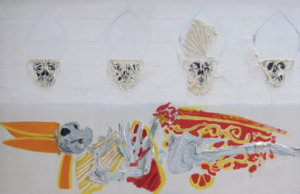
While the artist was working in Carrara in 1968, his father died. Ipoustéguy had often repeated a story about how, at the moment he began to sculpt:
My father was a worker and a carpenter, and he was very worried about my future. And, one day, I said to him at the table, “don’t worry, I will make you into a pope.” [24]
Before the burial, he made casts of his father’s face and hands. These were subsequently cast in silvered bronze and inserted into his sculptural ensemble, which shifted from Death of the Pope to Death of the Father. A moving page from Ipoustéguy’s Carrara sketchbook is inscribed “in memory of the father” and bears a drawing of his father’s face in the repose of death. “I had my dead father before me,” he lamented, “and it is still difficult to talk about. I said: ‘I will keep my promise. I will make you into a pope.'” [25]
This sketchbook also contains a press cutting from the November 1967 issue of the newspaper Le Monde, announcing the publication of Robert Merle’s Un animal doué de raison, illustrated with two dolphins. This novel, which had just appeared, was a thriller focusing on the intelligence of dolphins and their potential use as trained instruments of war. The same sketchbook bears a thought noted by Ipoustéguy that seems to relate to it: “the objectivity conferred by social collectivity.” [26]
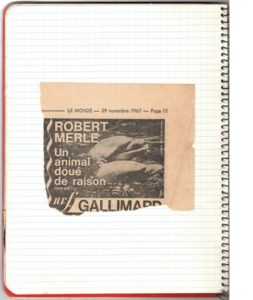
It is fascinating to wonder whether Ipoustéguy may have thought at the time that the basilical form of his Death of the Father installation also resembled the movement of a group of dolphins crossing the ocean, the hierarchical structure of Catholic Church processions and rituals reflecting the collective social structure of dolphin communities travelling together for mutual benefit and support. The artist’s daughter, Marie-Pierre Robert, noted that “the photographed dolphins, with their diaphanous and gleaming skin, resemble the double mitres of bishops, tilted at an angle.” [27] Or perhaps he considered himself the heir to his father’s legacy, the dauphin of Eugène Robert – alluding to the way heirs to the French throne were traditionally known, and bore dolphins as a royal symbol, a practice that descended from the Dauphiné region on the Mediterranean in southern France? [28] However, against this harmonious and noble suggestion stands this Oedipal declaration by the artist:
His son, that’s me, murdering his father. The father is going to die… The one above is the father’s murderer… I am finishing off my father. I will be finished off by my own children. [29]
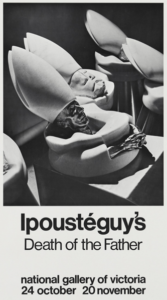
The National Gallery of Victoria chose to unveil the acquisition of Death of the Father with great fanfare on 24 October 1972, displaying it in a gallery dedicated to temporary exhibitions, where it was placed at the centre of a theatrical sound and light installation. Here, the lights were dramatically dimmed at ten-minute intervals, casting the sculptural group into striking chiaroscuro. This was accompanied by a soundtrack.
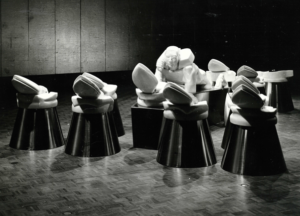
Sound and light installation of Death of the Father, National Gallery of Victoria, October–November 1972
The following day, Patrick McCaughey, thirty-year-old art critic of The Age, came out of the woodwork. While the front page of that newspaper featured a close-up image of the sculpture, McCaughey launched a highly virulent attack in its pages against both the artist and the work itself. “Who is Ipoustéguy? You may well ask,” he thundered, before continuing:
He is a minor European sculptor on whom the National Gallery has chosen to make its largest single expenditure from its own funds. They have confused the appeal of being bloody-minded and resolute with being simply ridiculous. If you really wanted an Ipoustéguy, and he can hardly be considered an urgent need, why spend so extravagantly to acquire this vast tombstone of his sculpture? … The sculpture itself, in gleaming white marble on aluminium boxes (get it, “the old and the new…”), is nothing but theatrical spectacle… What can one say about so much vulgarity? The finish is astonishing, the marble streaming and gleaming like plastic. But the finish is nothing compared to the kitschiness… This is the 1970s rerun of that good old nineteenth-century crowd-pleaser, the tableau vivant. Madame Tussaud enters the National Gallery of London. [30]
McCaughey’s caustic diatribe was juxtaposed with the statement of NGV director Eric Westbrook, who declared that Death of the Father was “an absolutely stunning and marvellous work.” [31] Alan McCulloch, the highly respected 65-year-old critic of The Herald, welcomed the acquisition, declaring:
This gigantic tour de force in polished Carrara marble well illustrates the reasons for Ipoustéguy’s fame as one of the greatest figurative sculptors in the world… It is an extraordinary work, perhaps an exhortation to consider the transience of flesh as opposed to the permanence of the spirit. [32]
Battle lines were now drawn, and the controversy over the new sculpture raged for months. Acknowledging that Death of the Father “hit like a lead weight against preconceived ideas,” Annette Dixon defended her purchase by declaring:
Such a work causes a little pain to those who champion abstract sculpture. This is a monumental and complex piece of the highest quality, combining the figurative and the abstract. It is a cerebral work, but passionate. It borders on poetry. [33]
Elsewhere, she is reported to have declared:
I think new attitudes and new approaches are always painful for some people, particularly those working in the art world. I believe in the sculpture. I think it is modern, new and contains a great deal of humanity. Ordinary people who have seen it, the men who lift it into place, the electricians adjusting the gallery lighting, say the sculpture has given them a great deal of confidence. [34]
The president of the NGV board, N. R. Seddon, questioned the appropriateness of McCaughey’s criticism:
Does he really need to be so discourteous in his comments? To write that the gallery is “damned stupid” is gratuitously offensive; to speak of “extravagant and ignorant waste” is equally offensive and suggests a claim to omniscience that is entirely unjustified. [35]
Meanwhile, Jane Semler of Ivanhoe wrote a stern letter to The Age, rebuking its critic’s superiority on aesthetic matters:
The sculpture is enormous in its concept and execution, and it will be with us far longer than Mr McC. Michelangelo was lucky that Mr McCaughey did not live in his time, when he completed the David, which in its new concept was lambasted by the cognoscenti. The world today would be the poorer if the McCaugheys of the time had had their wish granted. [36]
A young Maureen Gilchrist, then a student in the fine arts department at the University of Melbourne, came to McCaughey’s defence:
Mr McCaughey’s criticism in contemporary art journals is undoubtedly the most “connected” of its kind in this country. If anyone is qualified to assess contemporary achievements both internationally and nationally, it is Mr McCaughey. His knowledge in this area is considerable and gallery buyers would render a great service to research in this country if they paid attention to his criticism instead of remaining blind. [37]
Ever diplomatic, Alan McCulloch devoted a second article to the sculpture, wondering whether it was “a literary paradox, a significant masterpiece, a magnificent failure? As weaknesses are weighed against strengths, opinions will no doubt go one way or the other.” He argued forcefully, however, that to fully appreciate Death of the Father “one must go back to the time when all art students with a respectable training engaged in exhaustive studies of human anatomy… Many promising careers foundered before its complex system of tendons and muscles, and few were subsequently able to profit from this ossuary exercise. Ipoustéguy is one of them. And in the context of modern sculpture, this achievement places him in a category apart. Ipoustéguy is a risen Lazarus. And it is perhaps for this reason that he is regarded by many with wonder and by some with horror.” [38]
Annette Dixon reacted with equanimity to the controversy surrounding the acquisition of Death of the Father, declaring that “strong and divergent reactions are a good indication that a contemporary work of art has some value, and I am delighted to see that the sculpture has generated so much interest.” [39] In private, however, she would later write to Ipoustéguy, in perfect French, to express her disdain for the state of art criticism in this country:
The sculpture has made an extraordinary impression here, and we are barely recovering from this little upheaval. After all, a work of art must be very powerful to shake deeply held ideas. I have kept for you some reviews and photographs that appeared in the newspapers, should you wish to have them as a memento. However, it is absolutely impossible to translate into French the absurdities of our art critics. [40]
She also privately received letters of support from Melbourne sculptor Phillip Cannizzo and from the inaugural director of the recently opened Harry McLelland Art Gallery in Langwarrin, Carl Andrew, who confided:
“I must admit that, having seen only a few very inadequate photographs, I had some doubts about the work. But the confrontation with reality was a moving experience. I regard it without doubt as one of the most important works in Australia.” [41]
A few days after the unveiling of Death of the Father, a hilarious “critique” of the gallery’s new sculpture arrived in the form of a three-metre-high papier-mâché “monster,” painted with red and green blotches. It was deposited at dawn at the entrance to the NGV on a four-wheeled ox-cart, accompanied by a brick, a can of petrol and a blade of grass. The work of a group calling itself the Melbourne Revolutionary Surrealist Society and entitled “Death of Capitalism,” this “monster” was classified as an obscene object and placed in the custody of the South Melbourne police department. NGV director Eric Westbrook then jovially remarked at the time:
“It’s a pity the police regard it as rubbish. I am pleased that there is a reaction to our new Ipoustéguy sculpture. If a group is sufficiently motivated to do something like that, it’s good. Art is something about which people should feel passionately.” [42]
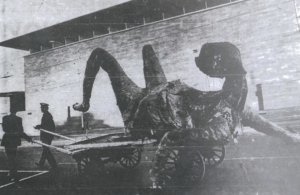
“Death of Capitalism” arrested by South Melbourne police, 6:15 am, 28 October 1972
Reporting on the arrival of this monstrous, alien-like form on the gallery’s doorstep, The Bulletin noted that “Eric Westbrook was delighted. It was just the extra boost he needed. ‘Death of the Father’ is now a bigger attraction than Bazza McKenzie.” Noting that “the cost of the sculpture represents 300,000 admissions at 20 cents,” The Bulletin also observed:
Melbourne is a city that does not normally get worked up over matters unless they are of capital importance: the quality of edible shark, the price of meat pies and the penalties handed down to footballers by the tribunal on Tuesday nights. It is therefore very pleasing to see citizens in a state of contradictory fury about a modern sculpture… but the controversy has been excellent for business. When your correspondent was there, the crowds were practically queuing to get in. A young woman declared: “I quite like it. It reminds me of the great marble in Rome. You know the one I mean, the big thing with the fig leaf.” [43]
Another local newspaper noted that “Elizabeth Dean, 11, from St Mary’s School in Colac, fell in love with it at first sight, saying: ‘If there was enough room, I’d love to have it in my bedroom.'” Conducting a direct survey, the newspaper also told its readers:
The attendant who watched over the sculpture seven hours a day for the past three weeks claims that “90 per cent” of the public appreciates it. But whatever the final verdict, the National Gallery is not going to have any regrets. “Death of the Father” is bringing them through the turnstiles at a rate of 700 people more per day than normal. [44]
The Age informed its readers that “housewives, businessmen, students, artists, schoolchildren and tourists crowded into the crypt-like atmosphere of the temporary exhibitions gallery to observe the work,” while The Sun reported: “‘It’s scary, like a horror movie,’ thought a little girl as she looked at Victoria’s latest art acquisition.” [45]
Death of the Father was championed by the art critic of The Sun, Jeffrey Makin. Under a headline announcing that “‘Death’ will silence the critics,” he proclaimed with some weight:
Ipoustéguy’s “Death of the Father” at the National Gallery is one of the most important art acquisitions ever made by an Australian gallery. It is a work that stands alongside Rodin, Moore, Rembrandt, Carracci and Bonnard. It needs no written justification. Like most great works, it has a presence, a right to exist. This presence will eventually reduce all its detractors to silence and plunge them into mute admiration. Even now, its reputation is the beginning of a legend.
He did, however, express reservations about the way the work was displayed, noting:
The spot lighting is too theatrical. One really needs to see it in a courtyard, with its centre of gravity at eye level. That means a platform. Apart from that, it is a breathtaking experience. [46]
The acquisition of Ipoustéguy’s sculpture by the NGV had become “the bête noire of the local art scene,” according to local art critic Terry Whelan:
Personally, I think it is a good thing. It has led to a revitalisation of our aesthetic thinking. Sixty thousand dollars may seem a Croesus-worthy ransom for an expensive parody of Manzu’s “Cardinals.” However, it has helped to clarify our ideas. It has offered the opportunity to re-examine our aesthetic theories, the role of the gallery in artistic circles and even our purchasing policies. The number of people who, out of aesthetic sectarianism, have refused to accept it as a work of art only magnifies our provincialism. Whether it is good or bad art is, of course, another debate. [47]
The controversy made headlines in various countries around the world, from the Philippines to Bangladesh, in a collective article in which Annette Dixon is reported to have declared: “Like me, the ordinary people who flock to the gallery seem to love it. It has generated more public interest than any other work we have exhibited here in many years.” [48] Newspapers and tabloids all delighted in photographing children interacting with the sculpture, seemingly all ignoring the erotic content of Death of the Father. Only one satirical article, in the iconoclastic Nation Review, addressed this subject, maliciously describing it as “sixty thousand dollars of your money and mine [spent] on a truncated bloke with a boner, casting an unnatural eye over his deceased father.” [49]
After being exhibited for a month in the Temporary Exhibitions Gallery, the Ipoustéguy was moved to the NGV’s Modern European Gallery on the second floor. [50] In January 1973, it was noted:
since Death of the Father was exhibited in late October 1972, it has been at the centre of a controversy among Australian art critics. Some adore it, others do not. The general public is flocking to the gallery in droves to see it. [51]
It would certainly have been judicious to keep the sculpture visible for the 40th International Eucharistic Congress, held in Melbourne in February 1973, which drew thousands of international Catholic visitors to the city, as well as “17 cardinals, five cardinal electors and hundreds of archbishops and lower-ranking clergy,” along with global religious superstar Mother Teresa. [52]
In early 1973, it was hoped that Ipoustéguy would soon come to Melbourne. Annette Dixon envisaged that he might visit two Italian bronze founders, Fernando Romei and Vittorio Carboni, who ran the Vittorio & Fernando Art Foundry in Moorabbin and were great admirers of his work. And she had another project in mind:
Now that everyone here has had time to look at and reflect on Death of the Father, I would like to ask you some general questions about your work and others more specific to the gestation of Death of the Father. A recording would be the best way to achieve such documentation. If you agree, I will prepare the questions in advance and in case you do not wish to answer some of them, we can cross out any that are untenable. A recording of this kind will help avoid misunderstandings that might be published in the future and will provide a good basis for further research. [53]
Unfortunately, this trip was never undertaken due to health problems the artist had with his kidneys, and then prior commitments in connection with another project in Germany. A golden opportunity lost to gather Ipoustéguy’s personal recollections of the new, controversial sculpture in Melbourne.
The attacks on Ipoustéguy resurfaced eighteen months later, when the Tolarno Gallery in Melbourne organised an exhibition of the artist’s sculptures and drawings at their St Kilda premises. The NGV acquired Study of a Woman, 1970, a sensual nude drawn in charcoal from this exhibition, which was inaugurated by the gallery’s board president, N. R. Seddon. Maureen Gilchrist, the new art critic of The Age, however, delivered a scathing review of what she called the “second opportunity for Melbourne to examine the sculptural sins of this minor figure from minor Europe.” Declaring Ipoustéguy to be “the most grandiose and eclectic of contemporary monolithic sculptors,” Gilchrist argued that “the sculptor’s second coming to this city can only underline the folly” of the NGV’s acquisition of Death of the Father two years earlier. Her vehement denunciation of the artist’s work was extraordinarily severe:
None of Ipoustéguy’s achievements deserve to be taken seriously. They are too derivative and too dramatic. Ipoustéguy’s rhetoric comes straight from the nineteenth century. Indeed, all his effects belong to outdated conventions of the past. The works are haunted by literary and art-historical allusions. [54]
Ironically, these very qualities, which McCaughey and Gilchrist – young critics writing in an Australia that had only recently embraced abstract expressionism and conceptual art – regarded as anathema, are precisely what makes Ipoustéguy’s work so fascinating today, now that the hegemony of Greenbergian formalist aesthetics and the tyranny of modernism’s reductive vision of art history have been set aside. Journalist Terry Ingram perfectly summarised the situation in 1972 when he wrote:
“As a figurative sculptor, Ipoustéguy will be outdated for critics who believe that everything that can be said about the human form has already been said.” [55]
In 1972, Patrick McCaughey ominously predicted:
“The only comfort of the situation is this: there is not enough room in the gallery to exhibit the thing, so it will only be shown on special occasions such as Ipoustéguy’s birthday or, perhaps, Father’s Day.” [56]
History proved him wrong. While there is no data on how frequently Death of the Father was exhibited in the 1970s and 1980s (though the author of this article recalls having seen it on several occasions during those decades), the sculpture was exhibited at the NGV in 2011, 2012, 2017 and 2020. In 1998, it was featured in a major retrospective exhibition of world religious art organised at the NGV by nun and art historian Rosemary Crumlin, Beyond Belief: Modern Art and the Religious Imagination. At that time, Geoffrey Edwards, senior curator at the gallery for sculpture and glass, acknowledged:
Given the formal and material austerity that characterises much twentieth-century sculpture, Ipoustéguy’s masterly and richly symbolic work is difficult to assimilate into the modernist canon. To some extent, its epic scale, the unexpected conjunction of media and the deployment of “serial” elements relate to the language of “installation.” However, such a notion is manifestly incompatible with a figurative marble sculpture tour de force. [57]
Interviewed in 1993, Ipoustéguy declared that had he not become an artist, he would have liked to be a musician or a gangster. [58] One might say he achieved both goals with Death of the Father, a work that offends the sensibilities of some, but for others soars visually to Wagnerian heights.
Dr. Ted Gott is the Senior Curator of International Art at the National Gallery of Victoria.
9 December 2024
Read the full article in the NGV Art Journal: https://www.ngv.vic.gov.au/essay/jean-ipousteguys-death-of-the-father-at-the-ngv-marble-metal-and-lots-of-ink/
Author’s note: I warmly thank the artist’s daughter, Marie-Pierre Robert, for her generous assistance in researching and writing this article. All translations from the French are my own. Where quotations are drawn from contemporary Australian media coverage, they do not include French accents or correct spelling, as these were not used in local newspapers.
Notes:
- John Hamilton, “Art? It was love at first sight,” The Herald, 25 October 1972.
- Annette Dixon, Jean Ipoustéguy, “Submission for acquisition,” 15 February 1972.
- Hamilton.
- Lenton Parr, undated letter in support of the acquisition of Death of the Father, c. Feb. 1972.
- Rebecca Edwards and Beckett Rozentals, “Hard edge: abstract sculpture 1960s–70s,” National Gallery of Victoria, https://www.ngv.vic.gov.au/essay/hard-edge-abstract-sculpture-1960s-70s/.
- Hamilton.
- Jean Ipoustéguy, Chroniques des jeunes années, 1997; cited in Flavio Arensi & Pascal Odille (eds.), Ipoustéguy. Eros + Thanatos, Palazzo Leone de Perego, Legnano and Allemandi & Co., Turin, 2008, p. 166.
- Ibid., p. 166.
- Jean Ipoustéguy, cited in Françoise Monnin, Ipoustéguy sculpteur, Éditions Meuse/Serge Domini, Metz, 2003, p. 19.
- Pierre Gaudibert, Ipoustéguy, Éditions Cercle d’art, Paris, 1989, p. 36.
- Ibid., pp. 36, 38.
- Évelyne Artaud, interview with Jean Ipoustéguy, in Gaudibert, p. 134.
- John Updike, Just Looking: Essays on Art, Museum of Fine Arts, Boston, 1982, p. 165.
- Bernd Krimmel, “Versuch über eine Bilderwelt,” in Ipoustéguy. Kunstpreis der Stadt Darmstadt, Kunsthalle Darmstadt, 1969, p. 10.
- Geneviève Breerette, “Le Chant somptuaire du sculpteur. Un entretien avec Ipoustéguy,” Le Monde, 6 July 1978; reprinted in Ipoustéguy. Werke 1956–1978, Staatliche Kunsthalle Berlin, 1979, p. 22.
- André Glucksmann, “La Mort du père,” in Ipoustéguy. Marbres, Galerie Claude Bernard, Paris, 1968; Annette Dixon, “Hand sheet about Ipoustéguy,” The Age, Melbourne, 8 November 1972.
- Paul Waldo Schwartz, “Paris commentary,” Studio International, vol. 176, no. 906, December 1968, p. 268.
- Évelyne Artaud, “Ipoustéguy, parlons…”, Éditions cercle d’art, Paris, 1993, pp. 115–116.
- Donald Millar, “Ipoustéguy: the art of Astonishment,” Art International, Zurich, vol. 14, no. 2, February 1970, pp. 44–45, 48.
- Jean-Dominique Rey, “Ipoustéguy: Un art qui fonce vers l’avenir,” Vie des arts, no. 61, Winter 1970–1971, p. 44.
- Jean Ipoustéguy, Carnet rouge, 1967–1968, collection Succession Jean Ipoustéguy.
- Jean Ipoustéguy, cited in Walter Lewino, Ipoustéguy, Galerie Claude Bernard, Paris, 1966.
- Jean Daive, interview with Jean Ipoustéguy, 2003, broadcast as part of the Mémorables series on France Culture, Radio France, 2006. I thank Marie-Pierre Robert for sharing this broadcast with me.
- Jean Ipoustéguy, cited in La Mort du père (1968) de Jean Ipoustéguy, 1974, Bertrand Renaudineau, 14 min. I thank Marie-Pierre Robert for sharing this film.
- Ibid.
- Ipoustéguy, Carnet rouge.
- Correspondence with Marie-Pierre Robert, 20 February 2024.
- See Alan Rauch, Dolphin, Reaktion Books, London, 2014, pp. 93, 106.
- Jean Daive, interview with Jean Ipoustéguy.
- Patrick McCaughey, “National Gallery buys a what?,” The Age, Melbourne, 25 Oct. 1972.
- John Messer, “It’s marvellous, says art chief,” The Age, 25 Oct. 1972.
- Alan McCulloch, “A bridge to new realism,” The Herald, Melbourne, 25 October 1972.
- Laurie Thomas, “Why? critics ask after gallery pays $60,000 for sculpture,” The Australian, Sydney, 26 October 1972.
- Hamilton.
- N. R. Seddon, “Gallery replies to a diatribe,” The Age, 1 November 1972.
- Jane Semler, “Letter to the editor: Michelangelo was lucky to have missed McCaughey,” The Age, 31 October 1972.
- M. Gilchrist, “Qualified and unqualified criticism,” The Age, 4 November 1972.
- Alan McCulloch, “Ipoustéguy: significant masterpiece or magnificent failure?,” The Herald, Melbourne, 1 November 1972.
- Dixon, “Hand sheet about Ipoustéguy.”
- Annette Dixon, letter to Jean Ipoustéguy, 26 April 1973. NGV conservation files.
- Phillip Cannizzo, undated letter to Annette Dixon; Carl Andrew, letter to Annette Dixon, 26 October 1972. NGV conservation files.
- Eric Westbrook, cited in “Hey D24… We’ve nabbed a monster!,” The Herald, Melbourne, 28 October 1972. See also “Is it art, litter, or obscene…?,” The Sun-Herald, Sydney, 29 October 1972.
- “Out and about with Batman: masterpiece or failure,” The Bulletin, 11 November 1972, p. 9. The Adventures of Barry McKenzie, directed by Bruce Beresford, had just been released in Australian cinemas at that time.
- Jill Graham, “$60,000 in polished marble and steel: Ipoustéguy’s Death of the Father. Just stone and metal, or?,” Postscript Weekender, Melbourne, 30 November 1972.
- Kevin Childs, “Good or bad they flock to see THAT work of art,” The Age, 26 October 1972; “Art? It’s spooky, says a critic,” The Sun, Melbourne, 26 October 1972.
- Jeffrey Makin, “The ‘Death’ will silence critics,” The Sun, Melbourne, 1 November 1972.
- Terry Whelan, “The arts,” Toorak Times, Melbourne, 8 November 1972.
- “Australian gallery acquires controversial French sculpture,” The Philippines Daily Express, Manila, 15 January 1973; “Controversial French sculpture for Australian gallery,” The Bangladesh Observer, Dhaka, 18 February 1973.
- Ted Neilson, “Ipoustéguy with red Qantas inflight relaxa-sox,” Nation Review, Melbourne, 11–17 November 1972.
- Annette Dixon, “Notes on the Gallery’s collections: La Mort du Père (Death of the Father),” Bulletin of the National Gallery Society of Victoria, December 1972, p. 3.
- “Controversial sculpture for Victoria,” Australian News, Melbourne, 11 January 1973.
- Robert Trumbull, “Catholic congress opens in Melbourne,” The New York Times, 19 February 1973, p. 8.
- Annette Dixon, letter to Jean Ipoustéguy, 26 April 1973.
- Maureen Gilchrist, “Ipoustéguy’s sculptural sins come up for a second viewing,” The Age, Melbourne, 8 May 1974.
- Tony Maiden and Terry Ingram, “It may be a boo boo, but … Melbourne ‘bargain’ rakes in the cash,” The Financial Review, Sydney, 27 October 1972.
- McCaughey, “National Gallery buys a what?”.
- Geoffrey Edwards, “Jean-Robert Ipoustéguy… les traits argentés et silencieux du père,” in Rosemary Crumlin (ed.), Beyond Belief: Modern Art and the Religious Imagination, National Gallery of Victoria, Melbourne, 1998, p. 122.
- Artaud, “Ipoustéguy, parlons…”
Dr Ted Gott
Senior Curator of International Art,
National Gallery of Victoria, Melbourne,
Australia